


What Are Ovarian and Uterine Cysts?
Ovarian cysts are fluid-filled sacs that develop on or within the ovaries.[^1] They’re one of the most common findings in reproductive-age women — an estimated 20% of women will develop at least one pelvic mass — a broader category that includes cysts and other growths — during their lifetime.[^1] The vast majority are benign and functional, meaning they form as a normal part of the menstrual cycle and disappear without intervention.
Uterine cysts are less common and tend to attract less attention. They’re fluid-filled structures found on or within the uterus or cervix, and in most cases, they’re incidental findings with no clinical significance.[^9]
Here’s the key distinction: the word “cyst” doesn’t automatically mean something is wrong. Many cysts are the body doing exactly what it’s designed to do.
What Are the Different Types of Ovarian Cysts?
Ovarian cysts fall into two broad categories: functional cysts (which arise from normal ovarian activity) and non-functional cysts (which develop from abnormal cell growth or other conditions).[^1][^3]
Functional Cysts
These are by far the most common. During a normal menstrual cycle, the ovary grows a dominant follicle and releases an egg. When that process doesn’t go exactly to plan, a cyst can form.[^1]
Follicular cysts: These develop when a follicle fails to rupture during ovulation and continues to grow, usually exceeding 2.5 cm. The granulosa cells produce excess estradiol, which can lead to decreased frequency of menstruation.[^1]
Corpus luteum cysts: After ovulation, the follicular remnant forms a corpus luteum — a temporary, hormone-producing structure that develops in the ovary once an egg has been released. If it doesn’t dissolve on schedule, it can fill with fluid or blood and grow to about 3 cm. A corpus luteum is typically present in early pregnancy, and it can sometimes form a cyst that usually resolves by the end of the first trimester.[^1]
Both types can become hemorrhagic cysts if they bleed internally — meaning a small blood vessel breaks and the cyst fills with blood. They’re generally asymptomatic and resolve spontaneously — 70–80% of follicular cysts disappear without treatment.[^1]
Key Insight:
Think of functional cysts as a minor detour in the menstrual cycle — the machinery is working, it just took an extra loop. Most correct themselves within one to three cycles.[^1][^2]
Non-Functional (Pathological) Cysts
Endometriomas: Also called “chocolate cysts” because they contain dark, thick, gelatinous aged blood products. Endometriomas arise from ectopic endometrial tissue growing on the ovary and appear on ultrasound with characteristic “ground glass” internal echoes. All that trapped, broken-down blood leaves them rich in iron and drives chronic inflammation and scarring in the surrounding ovarian tissue — part of why they tend to be harder on the ovary than other cysts. Endometriomas also slightly raise the risk of certain ovarian cancers — particularly the clear cell and endometrioid types — although the absolute risk remains low.[^1][^5][^6][^17]
→ Learn more: Endometriosis
Dermoid cysts (mature cystic teratomas): These contain elements from all three embryonic germ layers — skin cells, sebaceous glands, sometimes hair or teeth. They account for more than 10% of all ovarian neoplasms. Although mostly benign, malignant transformation occurs in 1–2% of cases — low, but enough that removal is usually recommended, particularly if the cyst grows over time.[^1][^18]
Cystadenomas: These develop from ovarian surface epithelium and come in two main forms: serous (filled with thin, watery fluid) and mucinous (containing thicker mucoid material). They’re benign but can grow large and typically require monitoring or surgical removal.[^1]
Cysts associated with PMOS: Polyendocrine metabolic ovarian syndrome (PMOS) is characterized by multiple small follicles (often called “cysts”) that accumulate due to disrupted follicular development and hormonal imbalance, including elevated androgens. The ovaries appear enlarged on ultrasound. PMOS affects 5–10% of reproductive-age women and is one of the primary causes of infertility.[^1]
→ Learn more: Polyendocrine Metabolic Ovarian Syndrome (PMOS)
Type | Contents / Appearance | Resolves Spontaneously? | Fertility Concern |
Follicular | Thin-walled, unilocular, fluid-filled. | Yes — 70–80% resolve. | Rarely a direct concern. |
Corpus luteum | Thick-walled; may contain blood or debris. | Yes — usually within one cycle. | Normal in pregnancy; rarely problematic. |
Endometrioma | Dark "chocolate"- coloured blood; ground-glass echoes on ultrasound. | No — requires monitoring or surgery. | Significant — strongest negative impact on ovarian reserve. |
Dermoid | Skin, hair, teeth, fat; complex on imaging. | No — surgical removal usually needed. | Generally low; depends on size and surgical approach. |
Cystadenoma | Serous (watery) or mucinous (thick) fluid. | No — monitoring or surgery indicated. | Low unless large or bilateral. |
Sources: Mobeen & Apostol (StatPearls, 2023);[^1] Sun et al. (2025)[^6]
What About Uterine Cysts?
Uterine cysts are far less discussed than ovarian cysts, but they do show up — usually as incidental findings. Most are benign and require no treatment.[^9]
Nabothian cysts: The most commonly encountered type. These small, mucus-filled cysts form on the cervix when squamous epithelium grows over the mucus-secreting glands, trapping their secretions. They’re typically a few millimeters in diameter, though they can occasionally reach 4 cm or larger. Nabothian cysts are benign, have no known association with malignancy, and usually require no treatment unless they cause symptoms like pain or cervical obstruction.[^9]
Paraovarian cysts: These sit in the broad ligament between the ovary and fallopian tube and account for 5–20% of adnexal masses, depending on the population and diagnostic criteria. (“Adnexal” simply means the area beside the uterus, where the ovaries and fallopian tubes sit.) Despite their frequency, fewer than 50% are correctly diagnosed before surgery.[^10][^11] Most originate from the mesothelium of the broad ligament (68%), paramesonephric duct remnants (30%), or mesonephric duct remnants (2%).[^10]
Gartner’s duct cysts: These arise from remnants of the Wolffian (mesonephric) duct along the vaginal wall. They’re benign and usually asymptomatic, though large cysts may cause discomfort or pressure symptoms. Surgical excision is the most common treatment when intervention is needed.[^12]
Cystic adenomyosis: Extremely rare — fewer than 50 cases are documented in the medical literature. This condition involves ectopic endometrial glands forming cysts within the uterine muscle wall, producing chocolate-brown fluid that bleeds cyclically. It typically presents in women aged 30–45 with symptoms that overlap significantly with fibroids.[^16]
→ Related condition: Uterine Fibroids, Myomas and Uterine Anomalies
What Symptoms Do Ovarian and Uterine Cysts Cause?
Most ovarian cysts produce no symptoms at all — they’re discovered incidentally during imaging or a routine pelvic exam.[^1] When symptoms do appear, they tend to include:
Unilateral lower abdominal pain or pressure — which can be intermittent or constant, sharp or dull.[^1]
Irregular menstrual cycles or abnormal vaginal bleeding.[^1]
A feeling of bloating or fullness in the pelvis, especially with larger cysts.
If a cyst ruptures or causes torsion (twisting of the ovary), the picture changes dramatically: sudden, severe, one-sided pain often accompanied by nausea and vomiting. Ovarian torsion is the relatively common gynecological emergency and requires immediate medical attention, because it cuts off the blood supply to the ovary and can cause permanent damage.[^1]
Important:
Sudden onset of severe pelvic pain — especially if one-sided and accompanied by nausea — may indicate ovarian torsion or cyst rupture. This is a medical emergency. Don’t wait for the pain to pass; seek care immediately.[^1]
Nabothian cysts on the cervix are almost always asymptomatic. In rare cases, large or multiple cysts can cause dyspareunia (painful intercourse), pelvic pain, or urinary retention from pressure on nearby structures.[^9]
Paraovarian cysts follow a similar pattern — typically silent until a complication arises. In one case series, 62.74% of patients presented with abdominal pain, while the rest were incidental findings.[^11]
How Are Ovarian and Uterine Cysts Diagnosed?
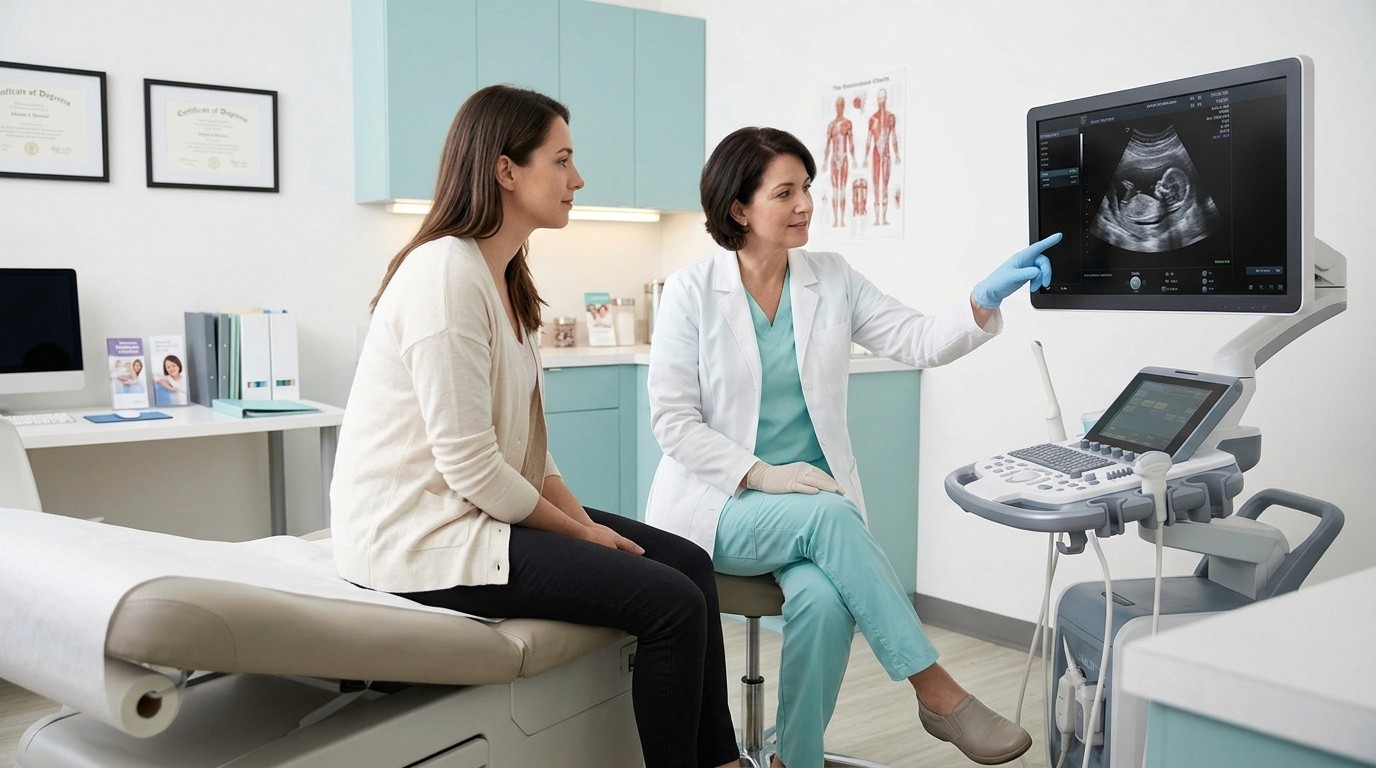
Transvaginal ultrasound (TVUS), often combined with transabdominal ultrasound, is the first-line imaging test for most suspected ovarian or adnexal cysts.[^1][^5] It’s minimally invasive, widely available, and highly effective at characterizing cysts and distinguishing benign ones from potentially concerning features.
→ Learn more: Ultrasound (Sonography)
What Does the Diagnostic Workup Look Like?
The first step is determining whether the patient is premenopausal or postmenopausal — this changes both the likely diagnosis and the management approach.[^1][^4] Pregnancy should be ruled out in premenopausal women before proceeding with further evaluation.
On ultrasound, features consistent with a benign cyst include thin, smooth walls; absence of septations, solid components, and internal flow on color Doppler ultrasound, which uses sound waves to measure blood flow.[^1]
Features that raise suspicion for malignancy include a cyst larger than 10 cm, complex multilocular morphology, papillary excrescences or solid components, thick septations, ascites, and increased vascularity on Doppler ultrasound.[^1][^4][^5]
CA-125 blood testing is most useful in postmenopausal women with an ovarian cyst, where an elevated level (above 35 U/mL) combined with suspicious ultrasound findings strengthens the case for further investigation. It’s less reliable in premenopausal women because CA-125 can be elevated by endometriosis, fibroids, and even normal menstruation.[^1][^4]
MRI or CT scans aren’t routinely part of the initial workup but may be used in selected cases — for example, when ultrasound findings are inconclusive, or malignancy is suspected.[^1][^5]
Finding | Likely Benign | Needs Further Evaluation |
Wall | Thin, smooth. | Irregular, thick. |
Septations | None. | Thick septations present. |
Solid components | None. | Papillary excrescences or solid areas. |
Size | Usually < 10 cm. | > 10 cm. |
Doppler flow | No internal vascularity. | High color Doppler flow. |
Other | No ascites. | Ascites present. |
Sources: Mobeen & Apostol (StatPearls, 2023);[^1] ACOG Practice Bulletin No. 174 (2016);[^4] ESGO/ISUOG/IOTA/ESGE Consensus (2021)[^5]
Can Ovarian Cysts Affect Fertility?
The answer depends entirely on the cyst's type and size. A simple functional cyst? Almost certainly not a problem. An endometrioma? That’s a different conversation.
How Do Cysts Affect Ovarian Reserve?
A 2025 study by Sun et al. compared ovarian reserve markers — anti-Müllerian hormone (AMH), follicle-stimulating hormone (FSH), and antral follicle count (AFC) — in women with different types of cysts with those of healthy controls. The results were striking: women with ovarian cysts had significantly lower AMH and AFC levels and higher FSH levels in this study (all p < 0.001).[^6]
Endometriomas had the most profound negative impact, with the lowest AMH values (1.17 ng/mL) compared to controls (4.61 ng/mL). Simple cysts and dermoid cysts also showed lower reserve markers, though less dramatically. Larger cysts were independently associated with greater reductions in AMH and AFC, regardless of type. A couple of caveats, though. These results come from the three cyst types the study looked at — endometriomas, simple cysts, and dermoid cysts — so they don’t necessarily extend to every kind of cyst. And the control group’s average AMH sat at the high end of the normal range, closer to what you’d see in a woman in her early twenties, so treat these as group averages rather than a personal forecast. AMH levels vary widely with age and testing method, and your result is best interpreted by a fertility specialist.[^6]
Bottom Line:
Both the type and the size of an ovarian cyst matter for fertility. Endometriomas are the biggest concern. Larger cysts of any type tend to mean lower ovarian reserve markers — which makes early evaluation and a clear treatment plan especially important if you’re planning to conceive.[^6]
What About IVF Outcomes?
A key 2015 meta-analysis by Hamdan et al. (33 studies) examined whether endometriomas specifically affect IVF/intracytoplasmic sperm injection (ICSI) results. Women with endometriomas had a similar live birth rate (OR 0.98) and similar clinical pregnancy rate compared to women without endometriomas, but they had fewer oocytes retrieved and a significantly higher cycle cancellation rate (OR 2.83).[^7]
That’s worth unpacking. The good news: having an endometrioma doesn’t doom your IVF cycle. The catch — and arguably the most important practical finding — is that your ovaries may respond less robustly to stimulation, and the risk of a canceled cycle is nearly three times higher. In real terms, a woman with an endometrioma is about three times more likely to have a cycle called off for poor ovarian response, which often means more stimulation cycles, higher costs, and a heavier emotional toll on the road to a live birth.[^7]
For functional cysts discovered during fertility treatment, the evidence is reassuring. A 2022 study of over 3,300 frozen embryo transfer (FET) cycles found that functional cyst formation following pituitary downregulation did not negatively impact pregnancy rates. The live birth rate was 54.5% in the cyst group versus 50.1% in controls — no significant difference. Conservative management was recommended over further drug suppression.[^8]
Paraovarian cysts may also be associated with infertility in some cases, possibly through mechanical effects, since they can narrow the fallopian tube and disturb its normal movement.[^11] In one case series, a patient with infertility conceived spontaneously five months after cystectomy.[^11]
→ Treatment option: In Vitro Fertilization (IVF)
What Are the Treatment Options?
Treatment depends on the patient’s age, menopausal status, cyst type and size, symptoms, and whether malignancy is suspected.[^1][^4]
When Is Watchful Waiting Appropriate?
Asymptomatic, unilocular cysts smaller than 10 cm can often be monitored with serial transvaginal ultrasound. In premenopausal women, these are usually benign; in postmenopausal women, further evaluation is more often warranted. Most functional cysts resolve spontaneously within one to three menstrual cycles. If a cyst persists beyond that window, it’s less likely to be functional and may require further evaluation.[^1][^4]
One common misconception: oral contraceptives don’t make existing functional cysts resolve faster. Although the pill reduces hormone production and prevents ovulation — which can prevent new cysts from forming — studies show it doesn’t accelerate the disappearance of cysts that are already there.[^2]
Key Insight:
The birth control pill can prevent new functional cysts, but won’t make an existing one shrink faster. If your doctor has recommended “watchful waiting,” that’s because time itself is the most effective treatment for functional cysts.[^2]
What Are the Monitoring Schedules for Non-Functional Cysts?
Endometriomas should be followed with ultrasounds 6–12 weeks after initial imaging, then yearly — and if they’re managed conservatively rather than removed, they should be monitored periodically over time.[^1]
Dermoid cysts also warrant yearly ultrasound follow-up until surgical removal.[^1]
When Is Surgery Needed?
Surgery is indicated for suspected ovarian torsion, persistent adnexal masses that don’t resolve, acute abdominal pain, and suspected malignancy.[^1]
Laparoscopy is the preferred approach — it involves smaller incisions, less blood loss, lower risk of infection, and shorter recovery times compared to open surgery (laparotomy). Laparotomy is reserved for patients who are hemodynamically unstable or when malignancy is strongly suspected.[^1][^21]
In premenopausal women, surgery prioritizes fertility preservation, and every effort is made to remove minimal ovarian tissue.[^1] A 2019 study by Gomez et al. found that ovarian cystectomy did not negatively impact the pregnancy rate or the live birth rate compared to controls.[^13] Similarly, Canis et al. (year needed) reported that the number of oocytes and embryos obtained was not significantly decreased by laparoscopic cystectomy for endometriomas larger than 3 cm, provided the procedure was performed by experienced surgeons.[^20]
But there’s a nuance. A 2023 review by Daniilidis et al. noted that while cystectomy may reduce recurrence rates and increase the likelihood of spontaneous conception, a postoperative reduction in AMH is to be expected, despite evidence of recovery during follow-up. The reduction in ovarian reserve is likely multi-factorial.[^14] And Shandley et al. (year needed) found that women with a history of ovarian cyst surgery were more likely to report a history of infertility — though it’s difficult to separate the effect of surgery from the underlying conditions that required it.[^15]
→ Learn more: Surgical Solutions for Infertility
For paraovarian cysts, conservative management is generally recommended for cysts smaller than 5 cm. Larger cysts, or those causing torsion or rupture, require surgical excision. Laparoscopy is the preferred approach, with every effort made to conserve the ovary and fallopian tube.[^10][^11]
Nabothian cysts almost never require treatment. If they’re symptomatic or if malignancy can’t be excluded, simple drainage or excision is performed.[^9]
What Happens if a Cyst Causes Complications?
Three classic complications bring women to the emergency department: rupture (often with bleeding), significant hemorrhage, and torsion.[^1]
Rupture and hemorrhage — most cases are physiological and uncomplicated. Women with stable vital signs and mild-to-moderate symptoms can often be managed with observation alone. Occasionally, significant blood loss leads to hemodynamic instability, requiring hospital admission, surgical evacuation, and blood transfusion.[^1]
Torsion — the complete or partial twisting of ovarian vessels that cuts off the blood supply. Current evidence supports a conservative approach during diagnostic laparoscopy: detorsion of the ovary with or without cystectomy is recommended to preserve fertility.[^1]
Paraovarian cysts carry their own complication profile. Because they lack a pedicle of their own, torsion usually involves the fallopian tube or the ovary as well. Two patients in one case series presented with torsion, one of whom was initially misdiagnosed as appendicitis.[^10]
So, What Should You Do Now?
If you’ve been told you have a cyst — or if you’re experiencing symptoms that could suggest one — here’s a practical path forward:
Step 1: Get a Proper Ultrasound Assessment
A transvaginal ultrasound is the gold standard for evaluating cysts. Make sure your scan is interpreted by a provider experienced in gynecological imaging — the difference between a “simple cyst, watch and wait” and “complex mass, needs further investigation” depends on skilled interpretation.
Step 2: Understand Your Cyst Type
Ask your doctor what kind of cyst you have. A functional cyst that will likely resolve in a few weeks requires a very different plan than an endometrioma or a dermoid cyst, which may require monitoring or surgery.
Step 3: Assess Your Fertility if Relevant
If you’re trying to conceive or planning to in the future, ask for an ovarian reserve assessment (AMH, FSH, AFC). This is especially important with endometriomas or larger cysts, where reserve markers can be significantly affected.
Step 4: Follow the Recommended Monitoring Schedule
Don’t skip follow-up ultrasounds. Functional cysts should be rechecked after one to three cycles. Endometriomas and dermoid cysts need yearly imaging. Persistence, growth, or new concerning features are all signals to escalate.
Step 5: Choose the Right Clinic
If surgery or fertility treatment is on the table, the skill and experience of your surgeon matters enormously — particularly for cystectomy, where ovarian tissue preservation directly affects future fertility. Compare clinics, ask about their surgical approach, and review outcome data.
→ Compare fertility clinics worldwide: MedicalNavigator.com/fertility-clinics
Too Long, Didn’t Read
Ovarian cysts affect roughly 20% of women at some point, and most are benign and resolve on their own without treatment.
Functional cysts (follicular and corpus luteum) are the most common type, and 70–80% resolve without treatment.
Endometriomas have the strongest negative impact on ovarian reserve; in one study, AMH values were nearly four times lower than in healthy controls.
Women with endometriomas undergoing IVF achieve similar live birth rates but face a nearly threefold higher cycle cancellation rate.
Oral contraceptives can prevent new functional cysts but do not accelerate the resolution of existing ones.
If surgery is needed, laparoscopic cystectomy is preferred to preserve ovarian tissue and future fertility.
References
[^1]: Mobeen S, Apostol R. Ovarian Cyst. [Updated 2023 Jun 5]. In: StatPearls [Internet]. Treasure Island (FL): StatPearls Publishing; 2026 Jan–.
[^2]: InformedHealth.org [Internet]. Cologne, Germany: Institute for Quality and Efficiency in Health Care (IQWiG); 2006–. Overview: Ovarian cysts. [Updated 2022 Apr 21].
[^3]: Bašković M, Habek D, Zaninović L, Milas I, Pogorelić Z. The Evaluation, Diagnosis, and Management of Ovarian Cysts, Masses, and Their Complications in Fetuses, Infants, Children, and Adolescents. Healthcare (Basel). 2025;13(7):775.
[^4]: American College of Obstetricians and Gynecologists’ Committee on Practice Bulletins—Gynecology. Practice Bulletin No. 174: Evaluation and Management of Adnexal Masses. Obstet Gynecol. 2016;128(5):e210–e226.
[^5]: Timmerman D, Planchamp F, Bourne T, et al. ESGO/ISUOG/IOTA/ESGE Consensus Statement on pre-operative diagnosis of ovarian tumors. Int J Gynecol Cancer. 2021;31(7):961–982.
[^6]: Sun X, Liu D, Guo Z, He L, Wang S. The influence of ovarian cyst type and size on ovarian reserve markers: implications for fertility counseling and preservation strategy. Front Endocrinol. 2025;16:1517789.
[^7]: Hamdan M, Dunselman G, Li TC, Cheong Y. The impact of endometrioma on IVF/ICSI outcomes: a systematic review and meta-analysis. Hum Reprod Update. 2015;21(6):809–825.
[^8]: Ji H, Su Y, Zhang M, et al. Functional Ovarian Cysts in Artificial Frozen-Thawed Embryo Transfer Cycles With Depot Gonadotropin-Releasing Hormone Agonist. Front Endocrinol. 2022;13:828993.
[^9]: Mikes BA, Puckett Y. Nabothian Cyst. [Updated 2025 Feb 17]. In: StatPearls [Internet]. Treasure Island (FL): StatPearls Publishing; 2026 Jan–.
[^10]: Durairaj A, Gandhiraman K. Complications and Management of Paraovarian Cyst: A Retrospective Analysis. J Obstet Gynaecol India. 2019;69(2):180–184.
[^11]: Singh S, Agarwal I, Begum J, Bhardwaj B. The burden of paraovarian cysts — a case series and review of the literature. Menopause Rev. 2023;22(2):105–110.
[^12]: Niu S, Didde RD, Schuchmann JK, Zoorob D. Gartner’s duct cysts: a review of surgical management and a new technique using fluorescein dye. Int Urogynecol J. 2020;31(1):55–61.
[^13]: Gomez R, Schorsch M, Gerhold-Ay A, Hasenburg A, Seufert R, Skala C. Fertility After Ovarian Cystectomy: How Does Surgery Affect IVF/ICSI Outcomes? Geburtshilfe Frauenheilkd. 2019;79(1):72–78.
[^14]: Daniilidis A, Grigoriadis G, Kalaitzopoulos DR, et al. Surgical Management of Ovarian Endometrioma: Impact on Ovarian Reserve Parameters and Reproductive Outcomes. J Clin Med. 2023;12(16):5324.
[^15]: Shandley LM, Spencer JB, Kipling LM, Hussain B, Mertens AC, Howards PP. The Risk of Infertility After Surgery for Benign Ovarian Cysts. J Womens Health. 2023;32(5):574–582.
[^16]: Kaur BD, Kaur P, Kaur M, Kaur M. Unraveling Cystic Adenomyosis: Diagnostic Odyssey and Surgical Resolution in a Multiparous Woman. J Midlife Health. 2024;15(4):302–305.
[^17]: Hoyle AT, Puckett Y. Endometrioma. [Updated 2023 Jun 5]. In: StatPearls [Internet]. Treasure Island (FL): StatPearls Publishing; 2026 Jan–.
[^18]: Shareef S, Ettefagh L. Dermoid Cyst. [Updated 2023 Aug 28]. In: StatPearls [Internet]. Treasure Island (FL): StatPearls Publishing; 2026 Jan–.
[^19]: Lasher A, Harris LE, Solomon AL, et al. Variables Associated With Resolution and Persistence of Ovarian Cysts. Obstet Gynecol. 2023;142(6):1293–1301.
[^20]: Canis M, Pouly JL, Tamburro S, Mage G, Wattiez A, Bruhat MA. Ovarian response during IVF-embryo transfer cycles after laparoscopic ovarian cystectomy for endometriotic cysts of >3 cm in diameter. Hum Reprod. 2001;16(12):2583–2586.
[^21]: Abduljabbar HS, Bukhari YA, Al Hachim EG, et al. Review of 244 cases of ovarian cysts. Saudi Med J. 2015;36(7):834–838.
This guide is for informational purposes only. Always consult qualified healthcare providers for personalized recommendations. For full details, read our Medical Disclaimer.

Author of the article
Date of publication