


What Is Ovulation Induction?
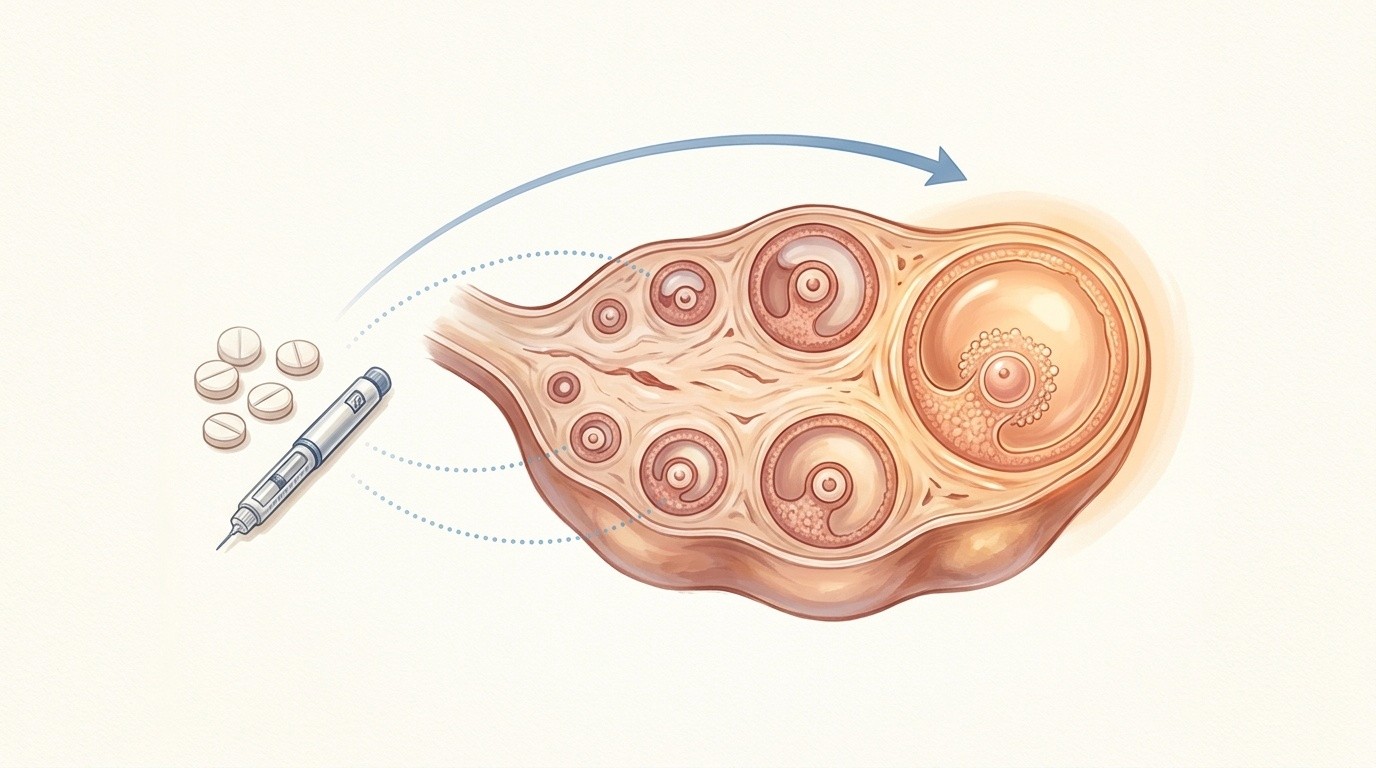
Ovulation induction (OI) is the process of using medications to stimulate the ovaries to produce and release eggs in women who have irregular or absent ovulation.[^1][^2]
According to the National Institute for Health and Care Excellence (NICE), ovulatory disorders account for approximately 20–30% of female infertility cases.[^1][^2]
Normal ovulation occurs roughly once every 28 days during a woman's menstrual cycle. Intervals of 21–35 days are considered acceptable.[^5]
When ovulation happens less often than every 35 days, it is called oligoovulation. When it stops altogether, it is called anovulation.
Ovulation induction may be done for two main reasons
1. You do not ovulate regularly — medications help the ovary mature and release eggs.
2. You ovulate normally but have not achieved pregnancy — medications may help you release more than one egg as part of a fertility treatment.
The goal of ovulation induction is to increase a woman's chances of conceiving, either through timed sexual intercourse, intrauterine insemination (IUI), or another fertility treatment.
When the absence of ovulation is a symptom of another condition, treating the underlying problem can also restore normal ovulation.
WHO Classification of Ovulatory Dysfunction
The World Health Organization (WHO) provides a classification system for ovulatory dysfunction that guides treatment. This classification helps doctors determine the most appropriate treatment based on hormone levels.[^3][^6]
Group | Gonadotropin Levels | Estrogen Levels | Cause / Example |
I | Low. | Low. | Hypothalamic–pituitary failure (for example, low body weight, excessive exercise). |
II | Normal. | Normal. | Hypothalamic–pituitary–ovarian axis dysfunction (most common — includes PCOS). |
III | High. | Low. | Primary ovarian insufficiency (POI) / hypergonadotropic hypogonadism. |
Source: Lindheim et al. (2018)[^6] and ESHRE Guideline (2020)[^3]
Approximately 85% of anovulatory patients fall under WHO Group II.[^6]
Where Does Ovulation Induction Fit in Infertility Care?
Ovulation induction is usually one of the first treatments used for infertility because it is non-invasive and relatively low-cost compared with other fertility treatments such as IVF. The standard treatment pathway typically follows this order:[^1][^7][^8]
Lifestyle modifications → Oral ovulation induction (letrozole or clomiphene) → Gonadotropin injections ± IUI → IVF
If you have PCOS and your BMI is 30 or higher, even modest weight loss (5–10%) may help restore ovulation and increase your chance of becoming pregnant without any further treatment.[^1][^23]
If oral medications do not work after approximately 6 cycles, your doctor may offer gonadotropin injections.[^1][^8] However, your doctor should explain the increased risks of multiple pregnancy and ovarian hyperstimulation syndrome (OHSS) before starting injectable treatment.[^8]
→ Learn more: Female Infertility
What Should Be Checked Before Starting Treatment?
Before starting ovulation induction, a complete workup should be performed to rule out underlying conditions:[^3][^6]
Complete menstrual, obstetrical, medical, and surgical history.[^6]
Laboratory tests — thyroid function, prolactin, day 3 FSH with estradiol, day 21 progesterone, anti-Müllerian hormone (AMH) for ovarian reserve.[^6]
Confirmation of tubal patency via hysterosalpingogram or saline infusion sonogram.[^6]
Semen analysis for the male partner (male factor is present in approximately 50% of infertile couples).[^6]
Assessment of body weight / BMI — a higher BMI may reduce response to medication; being underweight may contribute to anovulation.[^1][^3]
Screening for sexually transmitted infections.[^6]
The ASRM Practice Committee recommends that clinicians start with simpler oral medications and escalate to gonadotropin injections only when the oral approach does not produce ovulation.[^8]
Letrozole — When Is It Used, and What Are the Pros and Cons?
Letrozole is a third-generation, non-steroidal aromatase inhibitor (AI) originally developed for the treatment of breast cancer. In 2000, the first pilot study demonstrated its effectiveness for ovulation induction in women with PCOS.[^6][^9]
How Does It Work?
Letrozole inhibits aromatase — the enzyme that converts testosterone to estrogen.[^6] This creates a temporary low-estrogen environment that signals the brain to produce more FSH. Because the increase in FSH is moderate and physiologic, letrozole typically promotes the development of one or two follicles rather than many.[^9]
Dosing
Initial dose: 2.5 mg daily for 5 days, starting on cycle day 2–5. Ovulation typically occurs 5–10 days after the last dose, though timing can vary between individuals. Maximum dose: 7.5 mg daily.[^6][^14] Still considered "off-label" per FDA guidelines, but widely used internationally as first-line treatment.
Always confirm your dosing with your doctor before starting treatment!
Key Results
In the landmark 2014 NEJM trial (n = 750 women with PCOS), letrozole produced roughly 1.4 times the live birth rate of clomiphene (27.5% vs. 19.1%).[^11]
Side Effects
Because letrozole does not block estrogen receptors, it avoids many of the antiestrogenic side effects common with clomiphene (hot flashes, mood swings). Reported side effects include headache, back pain, and fatigue.[^6][^10] OHSS is rare with letrozole.[^12]
→ Learn more: Polycystic Ovary Syndrome (PCOS)
Clomiphene Citrate — When Is It Used, and What Are the Pros and Cons?
Clomiphene citrate (CC) is a selective estrogen receptor modulator (SERM) that has been a first-line treatment for anovulation for more than 40 years.[^6][^14]
How Does It Work?
CC competes with natural estrogen at receptors in the hypothalamus and pituitary. It binds for weeks rather than days, blocking the normal estrogen feedback. The brain "thinks" estrogen is low, so it increases production of FSH and LH, which stimulates follicle growth.[^6][^14]
Dosing
Typical starting dose: 50 mg orally for 5 days, beginning on cycle day 2–5.[^6][^14] If ovulation does not occur, the dose can be increased in a "stair-step" protocol by 50 mg increments. Maximum dose: typically 150–200 mg/day in most clinical protocols.[^14]
Always confirm your dosing with your doctor before starting treatment!
Key Results
Almost 80% of women using CC will ovulate over several months of treatment, although pregnancy rates are lower due to other factors, such as endometrial effects.[^4] The live birth rate (LBR) associated with CC monotherapy is approximately 23.3%.[^6]
Side Effects
Common: hot flashes, mood swings, headaches, and visual disturbances (diplopia, scotoma, photophobia).[^6][^15] Risk of multiple pregnancy is 5–8% for twins; less than 1% for triplets or higher.[^4]
How Do You Choose Between Letrozole and Clomiphene?
The 2014 NEJM trial by Legro et al. is the landmark study that shifted clinical practice. In 750 women with PCOS:[^11]
Outcome | Letrozole | Clomiphene Citrate |
Live birth rate | 27.5%. | 19.1%. |
Ovulation rate | 61.7%. | 48.3%. |
Risk of twins | 3.4%. | 7.4%. |
OHSS rate | Lower. | Higher. |
Endometrial thickness | Better preserved. | May thin the lining. |
Cost per cycle | Generally lower. | Varies by region. |
Half-life | Approximately 45 hours. | 5–6 days. |
Source: Legro et al. (2014)[^11]; Lindheim et al. (2018)[^6]; Wasim et al. (2024)[^17]
A 2024 study by Wasim et al. confirmed that letrozole is the better treatment choice compared to clomiphene citrate in terms of pregnancy and live-birth rates.[^17]
In short:
For women with PCOS, letrozole is emerging as the preferred first-line oral medication for ovulation induction. Letrozole tends to be less expensive than clomiphene, though costs vary by country and healthcare system. Clomiphene remains an effective, well-studied, and affordable option — especially for women without PCOS or those who do not respond to letrozole.
What Are Gonadotropin Injections (FSH/HMG)?
When oral medications fail, the next step is injectable gonadotropins — FSH-based medications that directly stimulate the ovaries with exogenous FSH, reducing reliance on endogenous hormonal signaling.[^6][^8]
Who Needs Gonadotropins?
WHO Group I patients (low gonadotropins) are ideal candidates because they lack an intact HPO axis and will not respond to CC or letrozole. Anovulatory or PCOS women who have failed oral OI are also candidates.[^6][^8]
What Are the Administration Protocols?
There are three standard protocols:[^6]
Step-up protocol: Starting dose of 75–150 IU, increased by 37.5–75 IU every 7–14 days if no response. Best for WHO Group I patients.[^6]
Low-dose step-up protocol: Starting at 37.5–75 IU to gently nudge a single follicle in PCOS patients. Fewer canceled cycles and safer results.[^6]
Step-down protocol: High initial dose (e.g., 150 IU) until a dominant follicle > 10 mm is identified; then the dose is reduced. May be considered in women of advanced reproductive age who require superovulation.[^6]
The goal of gonadotropin treatment is to promote the development of a single mature follicle. When a follicle reaches 16–20 mm, an hCG injection (the "trigger shot") is given to cause ovulation 24–36 hours later (this timing is used to plan intercourse or IUI).[^6][^8]
Key Results
Ovulatory rates of 70–72% in PCOS women, with a 15–30% live birth rate per cycle, depending on patient characteristics and monitoring protocols.[^6] Gonadotropins carry the highest risk of multiple pregnancy (up to 36% when strict cancellation criteria are not followed).[^8]
The ASRM recommends that gonadotropins should only be used by clinicians with appropriate training and experience.[^8] Strict cycle cancellation criteria should be in place to minimize the risk of multifetal gestation.[^8]
Individual dose selection is important. A 2025 study by Schouten et al. developed a dose-selection model to optimize FSH doses for each patient, accounting for factors such as AMH levels, BMI, and age.[^21]
What Are the Safety Risks and Complications?
Multiple Pregnancy
Multiple pregnancy is the most common complication of ovulation induction.[^1][^6][^8] The chance of twins is 5–8% with CC and letrozole; less than 1% for triplets or higher.[^4] Gonadotropins carry a much higher risk — up to 31.8% for multiple gestation.[^6] To reduce this risk, your response should be monitored by ultrasound during treatment.[^1]
Ovarian Hyperstimulation Syndrome (OHSS)
OHSS occurs when the ovaries over-respond to fertility drugs.[^1][^5] Mild symptoms (bloating, nausea, mild abdominal discomfort) are relatively common and usually self-limiting. Moderate OHSS — with more pronounced symptoms and detectable ascites — is less frequent. Severe OHSS can lead to significant complications, including marked ascites, haemoconcentration, and thromboembolic events.[^6]
OHSS is rare with oral agents (letrozole and clomiphene). Gonadotropins carry a higher risk, with moderate OHSS reported in up to 3–8% of monitored cycles, though strict cancellation criteria can reduce this further.[^6][^8]
Long-Term Safety
Current evidence does not show a clear increase in cancer risk associated with the use of fertility drugs for ovulation induction in women or in children born as a result of treatment.[^1] A Cochrane review of fertility drugs and cancer risk found no significant increase.[^6]
No difference in overall rates of congenital malformations has been observed between letrozole and CC (3.9% vs. 4.5%).[^6] Available evidence does not show an increased risk of congenital anomalies compared with natural conception.[^4][^6]
What to Do When It Doesn't Work
Patients who fail to respond to CC at maximum doses or who do not ovulate after 6 treatment cycles are considered CC-resistant and will require alternative or combination therapies.[^6]
Non-Response (CC-Resistant Patients)
Options include:
Switch to letrozole.[^1][^6]
Add metformin to the oral regimen — particularly in women with PCOS and evidence of insulin resistance.[^6]
Escalate to gonadotropin injections.[^1][^8]
Laparoscopic ovarian drilling (LOD) — a surgical option for CC-resistant PCOS patients with a live birth rate of 24–44%.[^6]
Referral to a reproductive endocrinology and infertility (REI) specialist.[^6]
Over-Response
If too many follicles develop (typically more than 2–3 follicles ≥ 16 mm), the cycle should be canceled to minimize the risk of multiple pregnancy and OHSS.[^8] Patients should be counseled on abstinence or barrier contraceptives during that cycle.[^8]
Low / Poor Ovarian Response
For women classified as "poor responders," individualized dose adjustments and specialized protocols may be considered.[^27] Multiple environmental and external factors — such as stress, lifestyle, and body weight — may also indirectly affect how the ovaries respond to medication.[^28]
→ Learn more: In Vitro Fertilization (IVF)
The Emotional Side — Psychological Aspects
Infertility treatment affects your mental health too.[^29] Studies show that stress, anxiety, and depression are common among couples undergoing ovulation induction and other fertility treatments.[^29][^30]
A 2015 systematic review by Frederiksen et al. found that psychosocial interventions — particularly cognitive behavioral therapy (CBT) — may improve psychological well-being and may be associated with improved pregnancy outcomes, although the evidence for a direct effect on pregnancy rates is less consistent.[^30]
One study found no real association between anxiety and the number of follicles or biological response to ovarian stimulation — meaning that feeling anxious does not reduce your chances of responding to treatment.[^31]
If you are struggling emotionally during treatment, talk to your care team. Support is available, and seeking it is a sign of strength, not weakness.[^30][^33]
So, What Should You Do Now?
If you suspect an ovulation problem or have been trying to conceive without success, here are your next steps:
Step 1: Track Your Menstrual Cycle
Record your cycle length for at least 3 months. Cycles consistently shorter than 21 days or longer than 35 days may signal an ovulatory disorder.
Step 2: See a Specialist
Book an appointment with a gynecologist or reproductive endocrinologist. Bring your cycle records and any previous test results.
Step 3: Complete the Pre-Treatment Workup
Your doctor should check hormone levels, tubal patency, and your partner's semen analysis before starting any medication.
Step 4: Understand Your Treatment Options
Ask your doctor to explain the differences between letrozole, clomiphene, and gonadotropins — including expected success rates, side effects, and monitoring requirements.
Step 5: Choose the Right Clinic
Not all clinics offer the same level of monitoring or expertise. Compare clinics, ask about their protocols, and choose a team you trust.
→ Compare fertility clinics worldwide: MedicalNavigator.com/fertility-clinics
Too Long, Didn't Read
Ovulation induction uses medications to help the ovary produce and release eggs — it treats approximately 20–30% of female infertility cases.
First-line oral options are letrozole and clomiphene citrate, both taken for 5 days early in the menstrual cycle.
Letrozole has roughly 1.4 times the live birth rate of clomiphene in patients with PCOS.
Gonadotropin injections are the next step if pills do not work — they carry higher risks of OHSS and multiples.
Multiple pregnancy is the main risk; ultrasound monitoring during treatment reduces this risk.
Current evidence does not show a clear link between OI drugs and cancer or birth defects.
References
[^1]: National Institute for Health and Care Excellence. Fertility problems: assessment and treatment (CG156): Treatments for women. NICE; 2013, updated 2017.
[^2]: Sharma M, Balasundaram P. Ovulation Induction Techniques. In: StatPearls [Internet]. Updated 2023 Jun 8.
[^3]: The ESHRE Guideline Group on Ovarian Stimulation, Ata B, Bosch E, Broer S, et al. ESHRE Guideline: Ovarian Stimulation in IVF/ICSI. Hum Reprod Open. 2020;2020(2):hoaa009.
[^4]: American Society for Reproductive Medicine (ASRM). Oral Medicines for Inducing Ovulation. Fact Sheet, Created 2021/Updated 2023.
[^5]: Women & Infants. Ovulation Induction.
[^6]: Lindheim SR, Glenn TL, Smith MC, Gagneux P. Ovulation Induction for the General Gynecologist. J Obstet Gynaecol India. 2018;68(4):242–252.
[^7]: Brigham and Women's Hospital. Instructions for Ovulation Induction Cycles.
[^8]: Practice Committee of the American Society for Reproductive Medicine. Use of exogenous gonadotropins for ovulation induction in anovulatory women: A committee opinion. Fertil Steril. 2020.
[^9]: Yang AM, Cui N, Sun YF, Hao GM. Letrozole for Female Infertility. Front Endocrinol. 2021;12:676133.
[^10]: Nagarajan D, K K V, V A, et al. Letrozole: Pharmacology, toxicity and potential therapeutic effects. Life Sci. 2022;310:121074.
[^11]: Legro RS, et al. Letrozole Versus Clomiphene for Infertility in the Polycystic Ovary Syndrome. N Engl J Med. 2014;371:119–129.
[^12]: Potiris A, Moustakli E, Migka F, Zikopoulos A, et al. Scoping Review of Letrozole in Assisted Reproductive Cycles: Efficacy and Outcomes Across Infertility Causes. Healthcare. 2025;13(13):1486.
[^13]: Mukherjee AG, Wanjari UR, et al. Letrozole: Pharmacology and Its Use in Infertility Treatment.
[^14]: Mbi Feh MK, Patel P, Wadhwa R. Clomiphene. In: StatPearls [Internet]. Updated 2024 Jan 11.
[^15]: Yilmaz S, Yilmaz Sezer N, Gönenç İM, İlhan SE, Yilmaz E. Safety of clomiphene citrate: a literature review. Cytotechnology. 2018;70(2):489–495.
[^16]: Brown J, Farquhar C. Clomiphene and other antioestrogens for ovulation induction in polycystic ovarian syndrome. Cochrane Database.
[^17]: Wasim T, Nasrin T, Zunair J, Irshad S. Efficacy of Letrozole vs Clomiphene Citrate for induction of ovulation in women with polycystic ovarian syndrome. Pak J Med Sci. 2024;40(1Part-I):78–83.
[^18]: Letrozole Versus Clomiphene Citrate and Endometrial Receptivity. Front Endocrinol.
[^19]: Weiss NS, Kostova E, Nahuis M, Mol BWJ, van der Veen F, van Wely M. Gonadotrophins for ovulation induction in women with polycystic ovary syndrome. Cochrane Database Syst Rev. 2019;1(1):CD010290.
[^20]: Broekmans FJ. Individualization of FSH Doses in Assisted Reproduction: Facts and Fiction. Front Endocrinol.
[^21]: Schouten N, Wang R, Torrance H, et al. Development and validation of a gonadotropin dose selection model for optimized ovarian stimulation in IVF/ICSI. Hum Reprod Update. 2025;31(2):116–132.
[^22]: LiverTox. Gonadotropins. National Institute of Diabetes and Digestive and Kidney Diseases; Updated 2018 Mar 26.
[^23]: Teede HJ, Tay CT, Laven JJE, Dokras A, Moran LJ, et al. International Evidence-based Guideline for the Assessment and Management of Polycystic Ovary Syndrome. J Clin Endocrinol Metab. 2023;108(10):2447–2469.
[^24]: Wang X, Wu J, Yang H. Ovarian stimulation protocols for poor responders: a network meta-analysis of randomized controlled trials. Arch Gynecol Obstet. 2023;307(6):1713–1726.
[^25]: Abu-Musa A, Haahr T, Humaidan P. Novel Physiology and Definition of Poor Ovarian Response; Clinical Recommendations. Int J Mol Sci. 2020;21(6):2110.
[^26]: Amaral S, Monteleone PAA, Serafini P, Baracat EC. Multiple environmental and external factors for inadequate response to ovarian stimulation in assisted reproduction: systematic review. J Reprod Genet. 2019;36(1):19–28.
[^27]: Szkodziak F, Krzyżanowski J, Szkodziak P. Psychological aspects of infertility. A systematic review. J Int Med Res. 2020;48(6).
[^28]: Frederiksen Y, Farver-Vestergaard I, Skovgård NG, Ingerslev HJ, Zachariae R. Efficacy of psychosocial interventions for psychological and pregnancy outcomes in infertile women and men: a systematic review and meta-analysis. BMJ Open. 2015;5(1):e006592.
[^29]: Donarelli Z, Lo Coco G, Gullo S, et al. Infertility-related stress, anxiety and ovarian stimulation: can couples be reassured about the effects of biological responses on reproductive technology? Biomed Soc Online. 2016;3:16–23.
[^30]: de Klerk C, Heijnen EM, Macklon NS, et al. The impact of mild ovarian stimulation combined with single embryo transfer with conventional IVF. Hum Reprod. 2006;21(3):721–727.
[^31]: Nesbit CB, Blanchette-Porter M, Bhatt A. Ovulation induction and insemination in women of advanced reproductive age: a systematic review of the literature. J Assist Reprod Genet. 2022;39(7):1445–1491.
This guide is for informational purposes only. Always consult qualified healthcare providers for personalized recommendations. For full details, read our Medical Disclaimer.

Author of the article
Date of publication