


What Is HSG (Hysterosalpingography)?
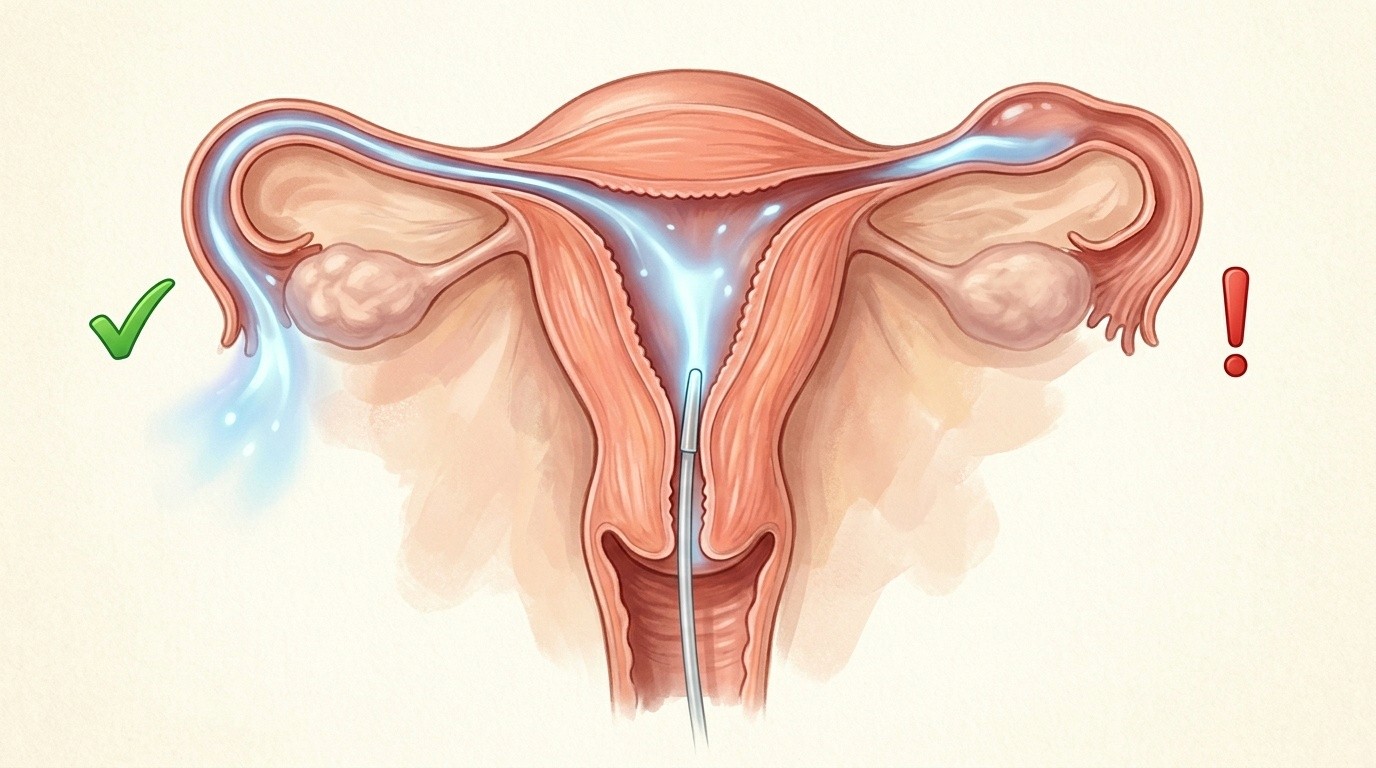
HSG is a diagnostic imaging procedure in which a contrast dye is injected through the cervix into the uterine cavity. Under fluoroscopy (live X-ray), the dye fills the uterus, flows through the fallopian tubes, and — if the tubes are open — spills into the surrounding abdominal cavity.[^1]
The entire process is recorded as a series of X-ray images, allowing the physician to evaluate:
Tubal patency — are the fallopian tubes open or blocked?
Uterine cavity shape — are there fibroids, polyps, adhesions, or congenital anomalies?
Peritoneal spill — confirmation that dye has exited the tube ends, proving patency.
HSG is one of the few non-surgical tests that can evaluate both fallopian tube patency and the uterine cavity in a single procedure. It is often used alongside other imaging, such as transvaginal ultrasound, hysteroscopy, or magnetic resonance imaging (MRI), for a thorough infertility assessment.[^1][^2]
→ Learn more: Female Infertility
When Is HSG Recommended?
According to the American Society for Reproductive Medicine (ASRM), a standard infertility evaluation should include assessment of the reproductive tract’s structure and tubal patency, and HSG is one of the recommended tests for this purpose.[^2] The European Society of Human Reproduction and Embryology (ESHRE) confirms that HSG is a valid test for tubal patency compared to laparoscopy with chromopertubation (a surgical procedure in which dye is passed through the fallopian tubes during laparoscopy to directly confirm whether they are open).[^3]
Infertility evaluation should assess both partners. While HSG focuses on female tubal and uterine factors, a concurrent semen analysis is equally important for identifying male-factor contributions.[^2]
What Are the Common Indications for HSG?
The American College of Radiology (ACR) lists the following conditions that may require HSG:[^4]
Infertility — the primary indication.
Suspected congenital uterine anomalies or anatomic variants.
Follow-up after tubal surgery, sterilization, or reversal procedures.
Evaluation before assisted reproductive technologies (IUI, IVF).
Recurrent pregnancy loss — to detect structural causes.
Pelvic pain, irregular menstrual cycles, or irregular vaginal bleeding.
When Should HSG Not Be Performed?
HSG should not be performed if you:[^1][^4]
Are pregnant or could be pregnant. In cases of irregular cycles or any uncertainty, a urine pregnancy test (hCG) may be required before proceeding.
Have an active pelvic infection or an untreated sexually transmitted infection.
Are experiencing heavy vaginal bleeding.
Have a known severe allergy to iodinated contrast media. If the reaction was moderate, premedication may be considered.[^4]
To reduce the chance of performing HSG during an early, unrecognized pregnancy, the procedure is typically scheduled in the follicular phase of the menstrual cycle (approximately days 7–11), after menstrual bleeding has stopped but before ovulation.[^4]
How Is the HSG Procedure Performed?
HSG is an outpatient procedure typically performed in a radiology suite. It does not require general anesthesia or an overnight hospital stay.[^1][^10]
Step-by-Step
Step | What Happens |
1 | You lie on the examination table in the lithotomy position (similar to a pelvic exam). A speculum is inserted into the vagina to visualize the cervix. |
2 | The cervix is cleaned with an antiseptic solution. A thin catheter or cannula is placed through the cervical opening into the uterus. |
3 | A contrast dye (an iodinated contrast agent visible on X-ray) is slowly injected through the catheter. The dye fills the uterine cavity and travels into the fallopian tubes. |
4 | Fluoroscopic X-ray images are captured at multiple stages: early filling (to detect defects), complete uterine filling (to assess uterine shape), contrast flow through the tubes, and spill into the peritoneal space. |
5 | The catheter is removed. You can typically go home the same day. |
Source: Cue L, et al. StatPearls (2024)[^1] and ACR Practice Parameter (2025)[^4]
Contrast media:
Two types of contrast media can be used: water-based contrast media (WBCM) and oil-based contrast media (OBCM). Water-based is more commonly used due to its lower risk of allergic reactions. Oil-based contrast has shown improved fertility outcomes compared to water-based contrast (see “Tubal Flushing Effect” below), but also carries a small risk of embolism.[^4][^3]
Does HSG Hurt? Managing Discomfort
HSG usually causes mild to moderate uterine cramping lasting about 5–10 minutes during the procedure. Some women may experience cramps for several hours afterward.[^10] The level of discomfort varies from person to person.
Pain Management Options
NSAIDs (ibuprofen, naproxen): Commonly recommended 30–60 minutes before the procedure. However, a Cochrane systematic review found that studies have not demonstrated significant pain reduction with NSAID prophylaxis alone.[^6]
Local anesthesia: Some clinicians may offer endocervical local anesthesia.[^1]
Slow injection: The contrast medium should be injected slowly to prevent tubal spasm and minimize discomfort.[^4]
Key insight:
Most patients can return home and resume normal activities immediately after the procedure. However, it is advisable to arrange for someone to drive you home if you experience lingering discomfort.[^10]
How Are HSG Results Interpreted?
A radiologist or gynecologist will analyze the X-ray images to determine whether the uterine cavity and fallopian tubes appear normal. Here is what the key findings mean:
Finding | What It Means | Next Steps |
Normal (patent tubes) | Dye flows freely through both tubes and spills into the peritoneal cavity. | Tubal factor is unlikely. Other causes of infertility are investigated. |
Unilateral tubal block | One tube is blocked. Pregnancy is still possible via the open tube. | Evaluate cause; possible laparoscopy or IVF. |
Bilateral tubal block | Both tubes are blocked. Natural conception is very unlikely. | Laparoscopy to confirm, or IVF to bypass the tubes. |
Hydrosalpinx | Fluid-filled, dilated fallopian tube. Toxic fluid may impair implantation. | Salpingectomy or tubal occlusion before IVF is often recommended. |
Uterine abnormality | Fibroids, polyps, adhesions (synechiae), a septate uterus, or congenital anomalies were detected. | Hysteroscopy may be needed for confirmation and/or treatment. |
Sources: Cue L, et al. StatPearls (2024)[^1]; Waheed KB, et al. Saudi Med J (2019)[^9]; ASRM Patient Fact Sheet (2023)[^10]
Important:
Approximately 30.7% of patients in a study of 303 women had abnormal HSG findings. Congenital malformations were more common in primary infertility, while surgery-related findings were more frequent in secondary infertility.[^9]
Müllerian (congenital) uterine anomalies are diagnosed in approximately 5% of all hysterosalpingograms.[^1]
→ Learn more: Tubal Factor Infertility
How Accurate Is HSG?
HSG is a well-established screening tool, but like any test, it has strengths and limitations. Its accuracy is typically reported against laparoscopy with chromopertubation — the gold standard for evaluating tubal patency.[^8]
What Does the Research Show?
Source | Sensitivity | Specificity | Notes |
ESHRE meta-analysis (7 studies, 4521 women)3 | 70% | 78% | Pooled, any tubal pathology |
ESHRE (18 additional studies)3 | 86% | 79% | Supporting data |
Sharma et al. — unilateral block8 | 85% | 96.4% | Accuracy 94.2% |
Sharma et al. — bilateral block8 | 81.8% | 98% | n = 105 |
G & M (Cureus) — tubal patency7 | 95.8% | 92.3% | n = 39 |
G & M (Cureus) — uterine abnormalities7 | 70% | 85.7% | Hysteroscopy: gold standard for uterine pathology |
Primary sources: ESHRE Guideline on Unexplained Infertility (2023)[^3]; Sharma et al. J Obstet Gynaecol India (2023)[^8]; G & M, Cureus (2025)[^7]
What Are the Limitations of HSG?
False-positive tubal blockage: Tubal spasm during the procedure can mimic obstruction. Administering an anticholinergic medication can help distinguish spasm from true blockage.[^1][^4]
Limited detection of subtle intrauterine pathology: HSG may miss small polyps or intrauterine adhesions. Although hydrosalpinx is often visible on HSG, small or early cases may still require confirmation with ultrasound or laparoscopy. Hysteroscopy provides superior detection of intrauterine conditions.[^7]
Cannot evaluate pelvic adhesions or endometriosis: HSG visualizes only the inside of the uterus and tubes — laparoscopy remains the gold standard for evaluating abdominal adhesions and endometriosis.[^3][^8]
Spatial limitation (2D imaging): HSG produces two-dimensional images, which means it can detect uterine anomalies but cannot reliably distinguish between them — for example, differentiating a septate uterus from a bicornuate uterus. Three-dimensional imaging, such as MRI, is typically recommended for further characterization.[^1][^9]
Operator-dependent: Variability in interpretation based on operator skill can affect diagnostic accuracy.[^7]
What Are the Alternatives to HSG?
Hysterosalpingo-contrast-sonography (HyCoSy): An ultrasound-based method that avoids radiation. ESHRE states that HSG and HyCoSy are comparable in diagnostic capacity; the choice depends on the clinician and the patient's preference.[^3]
Laparoscopy with chromopertubation: The gold standard. Allows direct visualization and simultaneous treatment of adhesions, endometriosis, and tubal pathology. However, it is invasive, requires general anesthesia, and is more costly.[^8]
Hysteroscopy: The gold standard for evaluating intrauterine pathology. Provides direct visualization of the uterine cavity and allows simultaneous therapeutic interventions.[^7]
HSG and laparoscopy are not alternatives; they are complementary in diagnosing tubal pathologies. HSG remains the primary screening procedure, while laparoscopy is reserved for confirmation and treatment.[^8]
Can HSG Improve Fertility? The Tubal Flushing Effect
One of the most intriguing aspects of HSG is its potential therapeutic benefit. Some evidence suggests that the physical act of flushing contrast through the fallopian tubes may itself improve fertility — a phenomenon known as the “tubal flushing effect.”
According to a systematic review and meta-analysis of 15 randomized controlled trials (3,864 women), cited in the ESHRE guideline:[^3]
Oil-soluble contrast vs. no flushing: Oil-based contrast may increase the odds of live birth (OR 3.27, 95% CI 1.57–6.85) and clinical pregnancy (OR 3.54, 95% CI 2.08–6.02).[^3]
Water-soluble contrast vs. no flushing: It is uncertain whether flushing with water-based contrast increases live birth rate (OR 1.13, 95% CI 0.67–1.91).[^3]
Oil vs. water-soluble contrast: In the largest trial (1,119 women), the oil-based group had significantly higher rates of ongoing pregnancy and live birth, with a shorter time to ongoing pregnancy (10.0 months vs. 13.7 months).[^3]
Based on this evidence, ESHRE suggests discussing the potential benefits and risks of oil-based contrast flushing with couples who have unexplained infertility.[^3]
Risks of oil-based contrast: Low overall, with intravasation — fluid accidentally entering the bloodstream during the procedure — being the most frequently reported complication. Since 1928, only 4 cases of serious embolism-related consequences have been reported. HSG should always be performed under fluoroscopic guidance to allow timely cessation if intravasation occurs.[^3]
→ Learn more: Unexplained Infertility
What Happens After HSG?
What Is Recovery Like?
After the procedure, most women experience mild cramping and vaginal spotting for one to two days, which is considered normal.[^1][^10] You can typically return to normal activities the same day.
Contact your doctor if you develop: foul-smelling vaginal discharge, severe abdominal pain, heavy vaginal bleeding, fever or chills, or fainting.[^1]
What Are the Risks and Complications?
Serious complications following HSG are uncommon.[^10]
Infection: Post-procedure pelvic infection may occur in 1.4% to 3.4% of cases, mostly in patients with a prior history of tubal disease.[^1]
Vasovagal reaction: Rarely, patients may feel lightheaded or faint due to cervical manipulation.[^1]
Radiation exposure: Radiation exposure from HSG is low and comparable to other routine diagnostic X-ray procedures. This exposure has not been shown to cause harm, even if conception occurs later in the same month.[^10]
Allergic reaction: Rare reaction to iodinated contrast dye. Inform your doctor of any known allergy to iodinated contrast media before your appointment.[^10]
What Are the Next Steps Based on Your Results?
Your doctor will use the HSG findings, along with other diagnostic tests, to create a treatment plan:
Normal HSG: If both tubes are patent and the uterine cavity is normal, your doctor will investigate other potential causes of infertility (ovulatory dysfunction, hormonal disorders, male factor).
Blocked tubes: Your doctor will likely recommend either a laparoscopy to directly view the tubes and attempt treatment, or in vitro fertilization (IVF) to bypass the tubes entirely.[^10]
Uterine abnormality detected: Hysteroscopy may be recommended to confirm the finding and, if indicated, treat it (polyp removal, fibroid resection, adhesion lysis, or septum correction).[^7]
→ Explore your treatment options: IVF, IUI, Surgical Solutions
So, What Should You Do Now?
If HSG is on your radar — or if you’ve already had the test — here’s how to move forward:
Step 1: Talk to Your Doctor About Scheduling
HSG is typically performed between days 7 and 11 of your menstrual cycle. Make sure pregnancy has been ruled out before the procedure.
Step 2: Prepare for the Procedure
Ask your doctor about taking an NSAID (such as ibuprofen) 30–60 minutes beforehand. Arrange for someone to accompany you home, just in case.
Step 3: Understand Your Results
Your radiologist or gynecologist will review the images with you. Normal findings indicate the investigation shifts to other potential causes; abnormal results may prompt further testing or treatment.
Step 4: Discuss Next Steps With Your Fertility Specialist
Whether the results are normal or abnormal, the next move depends on the full clinical picture — including your partner’s evaluation, your medical history, and your treatment goals.
Step 5: Choose the Right Clinic
If you need specialized care — whether it’s laparoscopy, hysteroscopy, or IVF — finding the right fertility clinic can make all the difference.
→ Compare fertility clinics worldwide: MedicalNavigator.com/fertility-clinics
Too Long, Didn’t Read
HSG is a short outpatient X-ray test that checks whether your fallopian tubes are open and your uterine cavity is normal.
It is typically scheduled in the first half of your menstrual cycle (days 7–11) to avoid overlap with early pregnancy.
Expect mild to moderate cramping — the procedure is short, though total visit time varies.
HSG is reliable for tubal patency screening (sensitivity 70–96%, specificity 78–98%) but has limited ability to detect subtle uterine pathology.
Oil-based contrast may boost fertility outcomes — discuss this option with your doctor.
Serious complications are rare, and most women resume normal activities the same day.
Always test both partners — HSG addresses the female tubal and uterine factors, but male-factor evaluation is equally important.
References
[^1]: Cue L, Mayer C, Martingano DJ. Hysterosalpingogram. [Updated 2024 May 6]. In: StatPearls [Internet]. Treasure Island (FL): StatPearls Publishing; 2025 Jan–.
[^2]: Practice Committee of the ASRM. Fertility evaluation of infertile women: a committee opinion. Fertil Steril. 2021;116:1255–65.
[^3]: ESHRE. Evidence-based guideline on Unexplained Infertility. 2023.
[^4]: American College of Radiology. ACR Practice Parameter for the Performance of Hysterosalpingography. 2025.
[^5]: Chalazonitis A, Tzovara I, Laspas F, Porfyridis P, Ptohis N, Tsimitselis G. Hysterosalpingography: technique and applications. Curr Probl Diagn Radiol. 2009;38(5):199–205.
[^6]: Hindocha A, Beere L, O’Flynn H, Watson A, Ahmad G. Pain relief in hysterosalpingography. Cochrane Database Syst Rev. 2015;2015(9):CD006106.
[^7]: G M, M S. Comparative Analysis of Hysterosalpingography and Diagnostic Hysteroscopy Findings in Infertility Evaluation. Cureus. 2025;17(4):e81789.
[^8]: Sharma P, Sunita S, Shrivastava N, Bhargava M. Comparison of Hysterosalpingography and Laparoscopy in the Evaluation of Infertility: A Prospective Study. J Obstet Gynaecol India. 2023;73(3):262–269.
[^9]: Waheed KB, Albassam MA, AlShamrani AG, et al. Hysterosalpingographic findings in primary and secondary infertility patients. Saudi Med J. 2019;40(10):1067–1071.
[^10]: ASRM. Hysterosalpingogram (HSG). Patient Fact Sheet. Revised 2023. ReproductiveFacts.org.
This guide is for informational purposes only. Always consult qualified healthcare providers for personalized recommendations. For full details, read our Medical Disclaimer.

Author of the article
Date of publication