



Why Does Preparation Matter for Semen Analysis?
Preparation matters because semen quality fluctuates — sometimes dramatically — based on what your body has been doing for the past two to three months.[^1][^4] A semen analysis is a laboratory test that evaluates a man’s ejaculate, measuring how many sperm are present, how well they move, and what they look like.[^1][^2] It remains the cornerstone of male fertility evaluation worldwide.[^1][^3]
The sperm production cycle — spermatogenesis — takes approximately 74 days from start to finish, and it runs continuously.[^1] That means the sperm in today’s sample started forming in the testes more than two months ago. A fever last month, a course of antibiotics six weeks back, or a stretch of poor sleep can all leave a fingerprint on what the lab sees today.
Many men feel anxious or embarrassed about this test. That’s normal. Modern fertility clinics are designed around making the process discreet and unhurried — and the test itself is the single most informative step you can take if you and your partner are trying to conceive without success.[^2][^3] Think of it as a snapshot, not a verdict.
How Many Days Should You Abstain Before Semen Analysis?
You should abstain from any ejaculation for 2 to 7 days before your semen analysis, with 3 to 5 days considered the practical sweet spot for a diagnostic sample.[^1][^2][^5] This is the standard recommendation from the World Health Organization (WHO), the American Urological Association (AUA), and the American Society for Reproductive Medicine (ASRM).[^1]
The biology and timing behind the rule are a balancing act. Too short an abstinence period reduces the volume and total sperm count, because the reproductive tract hasn’t had time to refill.[^5][^6] Too long, and motility starts to drop while DNA fragmentation rises, because sperm sitting in the epididymis age and accumulate damage.[^5][^6][^7] The 3–5 day window is where most labs see the cleanest, most representative sample.
TIP FROM THE EMBRYOLOGIST Find out the abstinence rules your clinic wants you to follow The WHO 2–7 day recommendation applies to a standard diagnostic semen analysis. But some clinics prefer 3–5 day windows, and some — especially when preparing samples for IVF or intracytoplasmic sperm injection (ICSI) cycles — may ask for just 1–2 days to reduce DNA fragmentation in the sperm used for fertilization.[^8] Your clinic may give different instructions depending on the context, and that is deliberate — follow them. |
One detail patients almost always overlook: the abstinence period must be accurately reported to the laboratory at the time of sample delivery.[^1] The lab uses this number to interpret your volume, count, and motility against the right reference range. Saying “about a week” when it was actually three days will distort how the report is read.
What Should You Do in the Weeks Before Semen Analysis?
In the weeks before your test, you’re not preparing the sperm — you’re preparing the factory. Because spermatogenesis takes approximately 74 days, lifestyle changes act on the entire maturation cycle, not just the sample you’ll produce.[^1] This is the opposite of the abstinence rule, which only affects the next ejaculation.
Which Lifestyle Factors Should You Address?
Smoking, excessive alcohol, and recreational drugs are all consistently linked to reduced sperm parameters — lower sperm concentration, reduced motility, poorer morphology, and higher rates of sperm DNA damage — across large reviews.[^4][^11] Quitting the night before the test changes nothing; quitting about three months out is what actually moves these numbers.
Diet matters too. A 2025 systematic review and meta-analysis found that adherence to a Mediterranean diet — high in vegetables, fruit, fish, and olive oil — was significantly associated with higher sperm count, total motility, progressive motility, and normal morphology.[^10] An earlier 2024 review of 10 studies found six showed positive associations between Mediterranean-style eating and seminal quality.[^9]
Body weight and physical activity belong on the same list. Obesity and physical inactivity are independently linked to lower sperm concentration and motility.[^14]
Heat exposure is more than just a sauna problem. A meta-analysis of ambient temperature found that high ambient temperature negatively affects semen volume, sperm count, concentration, motility, and normal morphology.[^13]
Mobile phones sit closer to home than most men want to admit. A 2023 study in Fertility and Sterility found that higher self-reported mobile phone use was associated with lower sperm concentration and total sperm count.[^12] Take the finding with appropriate caution — but if your phone lives in your front pocket, this is one of the easier things to change.
TIP FROM THE EMBRYOLOGIST Drop the bad habits to raise the quality of your analysis Research and real-life experience show the same thing: men who stop smoking, cut excessive alcohol, drop recreational drugs, and start living healthier can significantly improve their sperm parameters. If you’re worried about your results, follow a healthier lifestyle and repeat the analysis in approximately 74 days — that’s the time it takes to see the changes in your semen quality.[^4] |
What About Recent Illness or Fever?
If you’ve had a high fever — 38°C (approximately 100.4°F) or above — anywhere in the spermatogenesis window of approximately 74 days, your results may not reflect your baseline.[^1][^2] Even a brief spike during the maturation window can significantly suppress sperm production and quality.
TIP FROM THE EMBRYOLOGIST If you’ve been sick — consider waiting before your analysis Sperm takes approximately 74 days to mature. A high fever during that window can suppress sperm production and quality, even if for a brief moment, and the result may not reflect your baseline. A repeat test after recovery is far more informative than rushing the analysis. There’s usually a specific section on the collection form where the receptionist asks whether you’ve been sick in the past 3 months — answer it carefully. |
Which Medications Can Affect Your Results?
Several common medications can suppress or alter sperm parameters across the maturation cycle. The most severe suppressants by far are testosterone and anabolic steroids, which can reduce sperm count to zero.[^4] But the list doesn’t stop there: long courses of antibiotics, Nonsteroidal Anti-Inflammatory Drugs (NSAIDs), antifungals, antihypertensives, and some antidepressants can all leave measurable effects.[^4][^11]
Even ibuprofen and paracetamol — the over-the-counter pills you reach for during a cold or a headache — have growing evidence of effects on semen parameters when taken regularly.[^11]
TIP FROM THE EMBRYOLOGIST If you’ve used serious medications recently — consider waiting before your analysis If there’s any medication you’ve been using systematically — even something as common as ibuprofen or paracetamol for a low-grade fever or headache — write it down on the collection form so the lab can interpret your numbers in context. Steroids, long courses of antibiotics, NSAIDs, antifungals, antihypertensives, and some antidepressants can all leave measurable effects on the maturation cycle. The lab needs the full picture to read your report correctly. |
→ Learn more: Steroids and Male Infertility
What Should You Do on the Day of Semen Analysis?
On the day of your test, focus on three things: collect the sample correctly, flag anything that went wrong, and — if you’re collecting at home — get it to the lab on time.[^1] Small mistakes here can invalidate weeks of preparation.
How Should the Sample Be Collected?
The standard collection method is masturbation into a sterile container provided by the clinic, similar to a regular urine container.[^1] Standard condoms, lubricants, and saliva are all either spermicidal — meaning they can damage or kill sperm — or contain compounds that affect motility. None of them can be used during collection.[^1]
If masturbation isn’t possible — for personal, religious, or medical reasons — collection during intercourse is allowed, but only with a specific non-toxic sperm collection device (SCD condom).[^1] These are not available at pharmacies and must be obtained from your clinic. Not every clinic stocks them, so ask in advance.
TIP FROM THE EMBRYOLOGIST Follow the rules about lubricants, saliva, and condoms Standard condoms or lubricants — including saliva — may be spermicidal, meaning they contain compounds that can affect your sperm motility and produce a result that doesn’t represent the true picture. And if you do use saliva, we can see it under the microscope: salivary epithelial cells are visible during analysis, so there’s no way to hide it. The result won’t represent your true sperm parameters, and the analysis may need to be repeated. |
Should You Collect at Home or at the Clinic?
Either is acceptable in most cases — provided you follow the rules. A 2023 systematic review and meta-analysis comparing at-home and in-clinic collection found little to no difference in volume, count, or motility.[^16] A separate observational study during the COVID-19 era (2021) confirmed no difference in semen parameters or pregnancy outcomes.[^15] Some men do produce slightly higher volume and concentration at home — likely because a familiar environment reduces anxiety — but the difference rarely matters clinically.
TIP FROM THE EMBRYOLOGIST Follow the rules when bringing the sample from home Some men prefer to collect the sample at home, and that doesn’t change anything for the lab — as long as all the rules have been followed. Bring the sample to the lab within 30–60 minutes after ejaculation, and keep it as close to body temperature as possible (tucked under a layer of clothing, not in a pocket near a phone or in the car cup holder). Label it with your full name, date of birth, and time of collection. And keep in mind the outside temperature — you may need to get to the clinic faster in winter, as cold temperatures can significantly affect your results.[^1] |
What If You Spill Part of the Sample?
The first fraction of the ejaculate is the most sperm-rich, because it contains the highest concentration of spermatozoa coming from the epididymis.[^18] If any part of the sample is spilled or collection is incomplete — especially the first portion — you must write this in the collection notes.[^18] There’s usually a specific section on the form for exactly this. These results shouldn’t be ignored, and if you’re concerned, it may be worth coming in for another collection, since a partial sample may not be fully representative.
Does the Time of Day Matter?
Time of day has a modest but real effect on semen parameters.[^17] The evidence is mixed: some studies show higher total motile counts in the afternoon, others find mornings are better, and the pattern differs between fertile and subfertile men. The practical advice is to collect at whatever time the clinic recommends — usually mid-morning — so that analysis occurs during core laboratory hours.[^17]
What Happens at Reception?
Bring photo ID. Reception needs to confirm your identity and won’t process the sample without it. Clinics typically schedule at least 30–60 minutes between collections to allow each patient time to get comfortable.
TIP FROM THE EMBRYOLOGIST Arrive on time, bring your ID, and don’t worry about time limits The receptionist needs to see your ID to confirm your identity, so make sure you don't forget it at home. Usually, there are no major time limitations between sperm collections — reception ensures at least 30–60 minutes between each collection, so that everyone has a chance to make themselves comfortable, calm their nerves, and reduce the anxiety as much as possible. If you didn’t manage to collect your sample due to nerves, you may ask for a later time, or ask whether you can bring the sample from home at a later time. Just make sure to follow the rules on home collection. |
→ Diagnostic test: Semen Analysis (Spermiogram)
What Should You Know When Reading Your Results?
Read your results as a complete picture, not as a series of pass/fail grades on individual numbers. Every parameter has a reference interval based on the WHO Laboratory Manual, 6th Edition (2021)[^18] — but those reference values are lower reference limits (5th percentile) — not passing grades.[^1][^18] A man with values below the threshold can father children naturally; a man with values above can struggle to conceive.
Why Does Morphology Look So Bad?
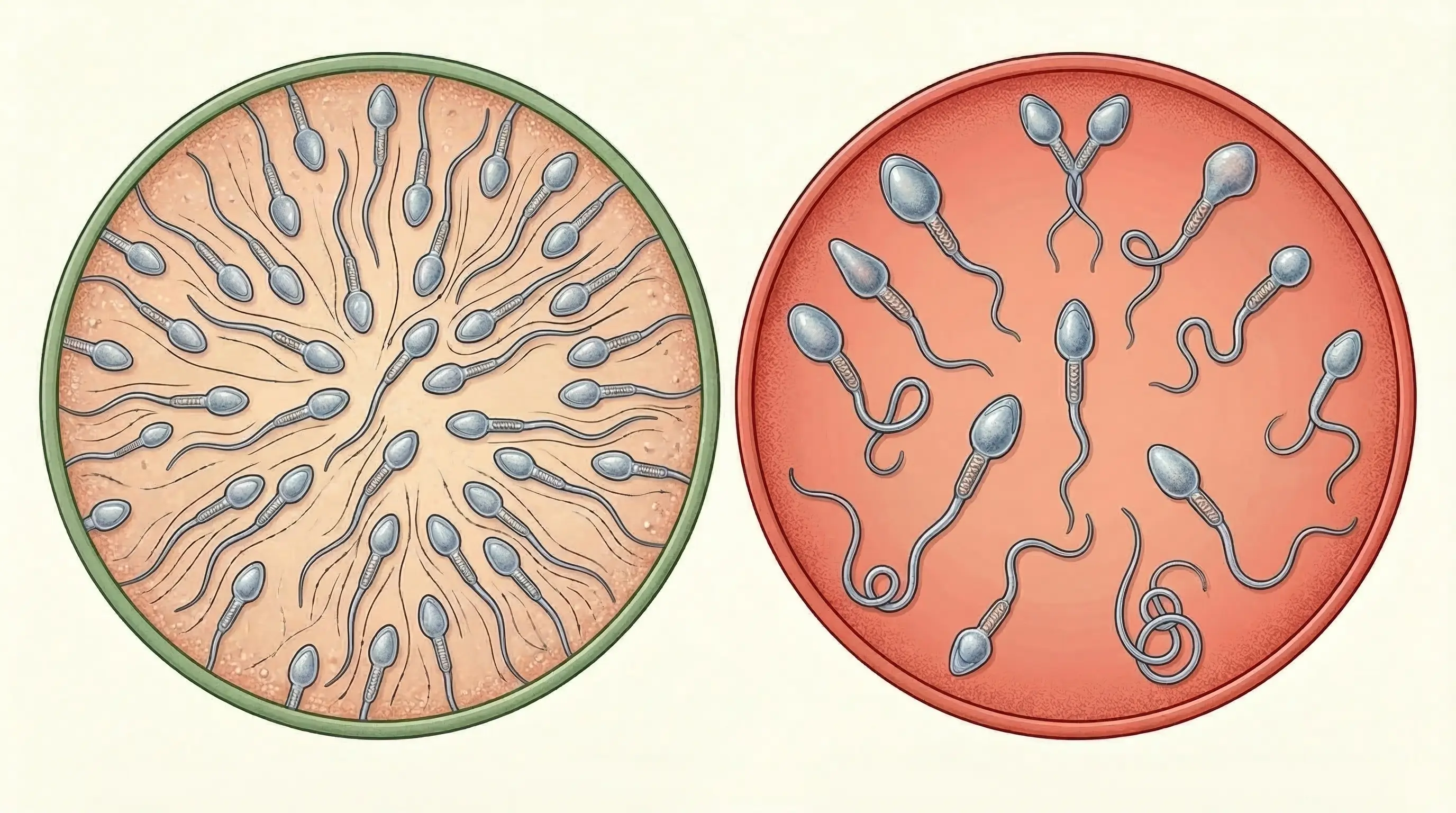
Morphology — the shape of the sperm — is assessed using strict Kruger criteria.[^1] The criteria are extremely precise, and the bar is set at 4% normal forms.[^18] Patients often see “4% normal, 96% abnormal” on their report and panic. Don’t.
Morphology alone does not entirely determine natural conception, and most fertile men in the population have normal morphology in the 5–10% range — though studies vary.[^18] The number looks harsh because the criteria are deliberately strict, not because your sperm are uniquely abnormal.
TIP FROM THE EMBRYOLOGIST Ask a specialist about your results — and read them as a full picture All analyses include reference intervals, so you can compare your results, but you should look at them as a whole rather than individual numbers. Men are always worried about the reference values for morphology, because the Kruger criteria are extremely precise and may seem harsh — it can feel like a bad result to have 4% normal and 96% abnormal sperm. But the truth is that morphology alone does not entirely affect natural conception, and most fertile men in the population may have a normal morphology of 5–10%, though studies vary. |
What Do the Numbers Actually Mean?
Concentration is reported in millions per milliliter. Even a result that looks low at first glance — say, 12 million/mL — needs to be read in the context of the volume.[^18] Volume × concentration = total sperm count. A man producing 4 mL of semen at 12 million/mL still has 48 million sperm in the ejaculate.
TIP FROM THE EMBRYOLOGIST Remember that your results are counted in millions While it only takes one sperm to fertilize the egg, the journey through the female reproductive tract is long — millions are needed at the start for reasonable odds. So even if one number drops because of motility or morphology, the total count of healthy sperm is often still high enough to matter. |
What If My Results Are Abnormal?
Don’t draw conclusions from a single sample. Sperm quality fluctuates by 25–50% between tests in the same individual due to stress, illness, abstinence variation, and normal biological variation.[^1][^4] The WHO and the European Association of Urology (EAU) explicitly recommend repeating an abnormal semen analysis — typically within 2–3 weeks for a quick recheck, or after a full spermatogenesis cycle of approximately 74 days if you’re testing whether a lifestyle change worked.[^1][^18]
TIP FROM THE EMBRYOLOGIST One result is never the whole picture If you’re worried about your results, talk to a specialist and book a second visit — either a few weeks later for a quick recheck, or approximately 74 days later so a full spermatogenesis cycle has had time to complete. |
→ Learn more: Conceiving Tips
How Should You Time Your Preparation?
Time each action to the stage of sperm maturation that it can actually affect. The table below maps every preparation step to the right window in the 74-day cycle.
Timing | Action |
90 days before | Stop smoking, reduce alcohol intake, limit heat exposure, and switch to a Mediterranean-style diet for the best possible baseline results. |
30 days before | Note any medications taken; flag fevers above 38°C; finalize lifestyle changes. |
7 days before | Begin the abstinence window — typically 3–5 days; confirm clinic instructions. |
Day of the test | Bring ID; collect into a clinic-provided container only; use no condoms, lubricants, or saliva; transport at body temperature within 30–60 minutes if collecting at home. |
After results | Don’t react to a single number; repeat after 2–3 weeks, or after approximately 74 days, as your specialist recommends. |
Sources: WHO Laboratory Manual, 6th ed.;[^1] Sunder M, Leslie SW. StatPearls;[^2] Chung E, et al. Arab J Urol (2023)[^18]
So, What Should You Do Now?
If your semen analysis is scheduled, here’s the order of operations.
Step 1: Confirm Your Clinic’s Specific Instructions
WHO’s 2–7-day abstinence rule applies to standard diagnostic analysis. Your clinic may want 3–5 days, or — for an IVF or ICSI cycle — 1–2 days to reduce DNA fragmentation.[^8] Different instructions are deliberate. Call ahead and confirm.
Step 2: Plan the 74-Day Window, Not Just the Week Before
Stop smoking, cut excessive alcohol, address obvious heat exposure, and review your medications with your doctor. If you’ve had a fever above 38°C in the past 3 months, mention it. Ideally, start these changes approximately 74 days before — the length of one full spermatogenesis cycle.
Step 3: Hit the Abstinence Window Cleanly
Aim for 3–5 days of abstinence unless your clinic says otherwise. Mark the calendar — don’t guess. You’ll need to report the exact number of days to the lab.
Step 4: Get the Collection Right
Bring photo ID. Use only the sterile container provided by the clinic. No standard condoms, no lubricants, no saliva. If you collect at home, deliver within 30–60 minutes at body temperature, with full name, date of birth, and collection time on the label. Note any spillage on the form.
Step 5: Treat One Result as a Snapshot
Sperm parameters fluctuate 25–50% between samples. Abnormal numbers almost always warrant a repeat — typically 2–3 weeks later, or approximately 74 days later if you’re testing the effect of lifestyle changes.[^1][^4]
Step 6: Choose the Right Clinic
Not every laboratory follows the WHO 6th-edition methodology. Not every clinic offers full male-fertility expertise alongside female evaluation. Compare clinics, ask about their lab protocols, and confirm both partners can be evaluated together.
→ Compare fertility clinics worldwide: MedicalNavigator.com/fertility-clinics
Too Long, Didn't Read
WHO recommends abstinence of 2–7 days before semen analysis, with 3–5 days considered the practical sweet spot.
Lifestyle changes affect sperm over approximately 74 days — quitting smoking the night before the test won’t help.
A high fever above 38°C in the past 3 months can suppress results, so a repeat after recovery is more informative.
Standard condoms, lubricants, and saliva can damage or kill sperm and must not be used during collection.
Home collection is acceptable if the sample reaches the lab within 30–60 minutes at body temperature.
Sperm parameters fluctuate by 25–50% between tests, so a single result rarely tells the full story.
References
[^1]: World Health Organization. WHO laboratory manual for the examination and processing of human semen. 6th ed. 2021.
[^2]: Sunder M, Leslie SW. Semen Analysis. [Updated 2022 Oct 24]. In: StatPearls [Internet]. Treasure Island (FL): StatPearls Publishing; 2026 Jan–.
[^3]: European Association of Urology. EAU Guidelines on Sexual and Reproductive Health — Male Infertility. 2024.
[^4]: Sciorio R, Tramontano L, Adel M, Fleming S. Decrease in Sperm Parameters in the 21st Century: Obesity, Lifestyle, or Environmental Factors? An Updated Narrative Review. J Pers Med. 2024;14(2):198.
[^5]: American Urological Association. Male Infertility — Medical Student Curriculum. AUA Education.
[^6]: Du C, Li Y, Yin C, Luo X, Pan X. Association of abstinence time with semen quality and fertility outcomes: a systematic review and dose–response meta-analysis. Andrology. 2024;12:1224–1235.
[^7]: Lo Giudice A, Asmundo MG, Cimino S, et al. Effects of long and short ejaculatory abstinence on sperm parameters: a meta-analysis of randomized-controlled trials. Front Endocrinol. 2024;15:1373426.
[^8]: Schlegel PN. Abstinence for sperm sample collection and ART outcome: an unsubstantiated myth. Curr Opin Obstet Gynecol. 2024;36(3):113–117.
[^9]: Piera-Jordan CA, Prieto Huecas L, Serrano De La Cruz Delgado V, et al. Influence of the Mediterranean diet on seminal quality — a systematic review. Front Nutr. 2024;11:1287864.
[^10]: Agarwal R, Salas-Salvadó J, Davila-Cordova E, et al. Mediterranean Diet, Semen Quality, and Medically Assisted Reproductive Outcomes in the Male Population: A Systematic Review and Meta-Analysis. Adv Nutr. 2025;16(8):100454.
[^11]: Rotimi SO, et al. Implications of lifestyle factors on male reproductive health. J Reprod Infertil. 2024;25(2):79–91.
[^12]: Rahban R, Senn A, Nef S, Roosli M. Association between self-reported mobile phone use and the semen quality of young men. Fertil Steril. 2023;120(6):1181–1192.
[^13]: Hoang-Thi AP, Dang-Thi AT, Phan-Van S, et al. The Impact of High Ambient Temperature on Human Sperm Parameters: A Meta-Analysis. Iran J Public Health. 2022;51(4):710–723.
[^14]: Melinawati E, Prakosa T, Budihastuti UR, et al. The Impact of Heat Exposure, Obesity, and Physical Activity on Sperm Quality: An Observational Study. Andrologia. 2023;9142450.
[^15]: Vagios S, Sacha CR, Hammer KC, et al. Social distancing protocol changes during the COVID-19 pandemic: the effect of at-home semen collection on intrauterine insemination outcomes. Hum Reprod. 2021;36(Suppl 1):deab130.033.
[^16]: Kerdtawee P, Salang L, Sothornwit J. Effect of semen collection location on semen parameters and fertility outcomes and implications for practice in the COVID-19 era: a systematic review and meta-analysis. Am J Obstet Gynecol. 2023;228(2):150–160.
[^17]: Bai S, Dou XC, Qi HL, et al. Association between semen collection time and semen parameters: an observational study. Asian J Androl. 2023;25(3):339–344.
[^18]: Chung E, Atmoko W, Saleh R, Shah R, Agarwal A. Sixth edition of the World Health Organization laboratory manual of semen analysis: Updates and essential take away for busy clinicians. Arab J Urol. 2023;22(2):71–74.
This guide is for informational purposes only. Always consult qualified healthcare providers for personalized recommendations. For full details, read our Medical Disclaimer.

Author of the article
Date of publication