


What Is Pre-implantation Genetic Testing?
Pre-implantation genetic testing (PGT) is a group of laboratory techniques and procedures used to screen or diagnose genetic abnormalities in embryos before they’re transferred to the uterus during an IVF cycle.[^1][^3] The concept is straightforward: instead of transferring an embryo and hoping for the best, a small number of cells are removed from the embryo trophectoderm and tested — giving the clinical team information about the embryo’s chromosomal or genetic makeup before a transfer decision is made.[^1]
PGT currently requires IVF, as embryos must be created and biopsied in a laboratory setting. That’s a detail worth emphasizing because couples who conceive naturally or through IUI sometimes ask whether PGT is an option — it isn’t, unless they switch to an IVF or ICSI cycle.[^1][^5]
→ Learn more: In Vitro Fertilization (IVF)
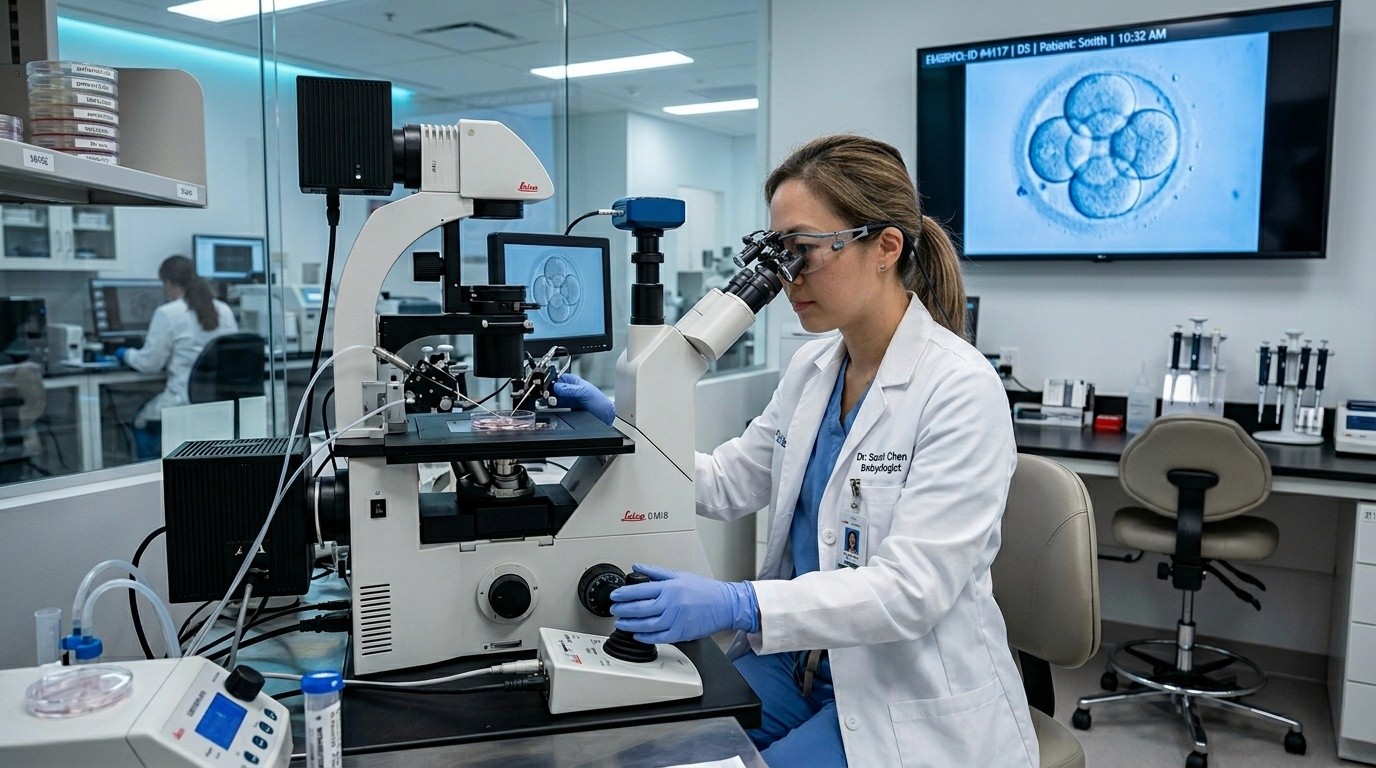
The testing itself occurs on day 5 or 6 of embryonic development, at the blastocyst stage. An embryologist removes 5–7 cells from the trophectoderm — the outer cell layer that will eventually form the placenta — using a combination of laser pulses and a delicate flicking motion of the pipette that detaches the cells while leaving the rest of the embryo intact.[^4] The inner cell mass (which develops into the fetus) is not directly biopsied.[^4] Think of it like sampling a few bricks from the outer wall of a house to check the building material, without touching the rooms inside.
After the biopsy, the embryo is vitrified (frozen), and the sample is sent to a genetics laboratory for analysis. Some larger clinics with their own genetics labs run the analysis in-house, but it’s costly and resource-intensive, so most send samples out. Results typically take 1–2 weeks, after which the clinic and patient decide which embryos are suitable for a frozen embryo transfer.[^5]
What Are the Three Types of PGT?
PGT comes in three forms, each designed to detect a different category of genetic problem.[^1][^2][^3] The abbreviations sound similar, but the clinical reasons for each test — and the evidence supporting them — are quite different.
Type | Full Name | What It Detects | Who It’s For |
PGT-A | Aneuploidy screening | Extra or missing whole chromosomes (e.g., trisomy 21, monosomy X) | Any IVF patient; most commonly offered to women over 35, after recurrent miscarriage, or repeated implantation failure |
PGT-M | Monogenic/single-gene disorders | Specific inherited conditions (e.g., cystic fibrosis, sickle cell disease, spinal muscular atrophy, Huntington’s disease) | Couples who are known carriers of a single-gene disorder or have an affected child |
PGT-SR | Structural rearrangements | Chromosomal translocations, inversions, deletions, or duplications | Individuals with a known chromosomal rearrangement (often identified after recurrent miscarriage or a karyotype) |
Sources: Fernandes & de Carvalho (2024);[^1] Giuliano et al. (2023);[^2] Tian et al. (2024)[^3]
A critical distinction: PGT-M and PGT-SR are diagnostic tests. They look for a specific, known genetic problem that runs in the family. PGT-A, by contrast, is a screening test — it casts a wide net across all 23 pairs of chromosomes, looking for random numerical errors.[^1][^6] That distinction matters because the evidence base for each is very different.
→ Learn more: Intracytoplasmic Sperm Injection (ICSI)
What Can PGT Detect — and What Can’t It?
PGT can identify specific chromosomal and genetic abnormalities in an embryo, but it doesn’t screen for everything.[^1][^21] Understanding its boundaries is just as important as understanding its capabilities.
What PGT Can Detect
PGT-A detects whole-chromosome aneuploidies (extra or missing chromosomes), segmental aneuploidies (partial gains or losses of chromosomal material), and mosaicism — a condition where some cells in the embryo have a normal chromosome count, and others don’t.[^1][^21]
PGT-M identifies single-gene mutations responsible for conditions such as cystic fibrosis, sickle cell disease, thalassemia, Huntington’s disease, and spinal muscular atrophy.[^2][^7] It requires a customized test design (called a probe) prepared weeks before the IVF cycle begins, using DNA samples (usually collected with a simple cheek swab) from the couple and sometimes other family members.[^7]
PGT-SR identifies unbalanced forms of known structural chromosomal rearrangements such as translocations and inversions.[^1][^5]
What PGT Cannot Detect?
A standard PGT-A result does not screen for single-gene disorders — that requires a separate PGT-M test.[^1] PGT also cannot detect multifactorial conditions (those caused by a combination of many genes and environmental factors), epigenetic abnormalities, or every possible chromosomal rearrangement.[^1][^21]
Important:
A “normal” PGT-A result is not a guarantee of a healthy baby. It means the tested cells had the expected number of chromosomes at the time of biopsy. It doesn’t rule out single-gene disorders, structural abnormalities not visible at this resolution, or complications unrelated to genetics.[^1][^6]
The Mosaicism Problem
Mosaicism is one of the most challenging aspects of PGT-A interpretation. Because only 5–7 trophectoderm cells are tested, and the trophectoderm represents the placenta (not the baby), the result may not perfectly reflect the inner cell mass.[^4][^21] Two different labs can produce different results from the same embryo, depending on the thresholds used to classify mosaic versus aneuploid embryos and reporting criteria.[^21]
The American Society for Reproductive Medicine’s (ASRM) 2023 committee opinion on mosaic embryos notes that transfers of mosaic embryos have shown “reassuring outcomes”, but recommends genetic counseling before proceeding.[^8] Here’s the practical takeaway: a mosaic result doesn’t automatically mean the embryo should be discarded.
→ Learn more: How to Understand Your PGT Result
Does PGT-A Actually Improve Live Birth Rates?
This is the most contested question in reproductive medicine right now, and the honest answer is: it depends on how you measure it.[^9][^10][^11]
When success is measured per embryo transfer, PGT-A does appear to help. A 2023 systematic review and meta-analysis by Kasaven et al. found that PGT-A at the blastocyst stage increased the live birth rate (LBR) and ongoing pregnancies per transfer, and reduced miscarriage rates compared to morphological assessment alone.[^10]
But when success is measured per cycle start — meaning from the moment you begin stimulation through all your frozen transfers from that retrieval — the picture shifts. Kucherov et al. analyzed 133,494 autologous IVF cycles from the U.S. SART CORS database and found that PGT-A was associated with decreased cumulative live birth rates (CLBR) in patients aged 40 and under.[^9] The negative association was especially pronounced in women under 35.[^9] But this was an observational analysis of registry data, not a randomized trial — so it can’t prove PGT-A caused the lower birth rates: the patients and clinics that choose PGT-A may simply differ from those that don’t.
Why the discrepancy? Because PGT-A excludes embryos based on biopsy results. Each transfer of a tested embryo is more likely to succeed, but you have fewer embryos to transfer overall — including some that may still have reproductive potential despite mosaic findings.[^9][^21] For younger women who produce many embryos, discarding any based on a test with inherent limitations can cost more than it gains.
Key Insight:
A 2021 network meta-analysis of randomized controlled trials found that PGT-A was associated with improved live birth rates, primarily in women over 35, in this analysis when performed on blastocyst-stage embryos.[^11] For younger patients, it offered no consistent or statistically significant benefit in most studies.[^11]
A single-center retrospective study by Wang et al. (2025) added nuance: for first frozen single-embryo transfers, PGT-A improved live birth rates compared to conventional IVF, regardless of the stimulation or endometrial preparation protocol used.[^12] Because this came from a single center, the result carries a risk of selection bias, and one clinic’s data may not reflect the broader picture the way a meta-analysis or randomized trial can. Here’s what that means in practice: if your clinic’s policy is to transfer one embryo at a time from a frozen cycle, PGT-A may help select the right one. But if you’re looking at the whole cycle’s potential, the maths gets murkier.
Study | Design | Key Finding |
Kucherov et al. (2023) | 133,494 cycles, SART CORS database | PGT-A associated with reduced CLBR in patients ≤40; most pronounced at age <35.[^9] |
Kasaven et al. (2023) | Systematic review and meta-analysis | PGT-A increased LBR per embryo transfer and reduced miscarriage.[^10] |
Simopoulou et al. (2021) | Network meta-analysis of RCTs | Improved LBR only in women >35 on blastocyst biopsy; no benefit in younger patients.[^11] |
Wang et al. (2025) | Single-center retrospective | PGT-A improved LBR for the first frozen SET.[^12] |
CLBR = cumulative live birth rate. LBR = live birth rate. SET = single embryo transfer.
Who Is PGT Recommended For?
The indications differ sharply depending on which type of PGT we’re talking about.[^6][^7]
PGT-M and PGT-SR: Clear Indications
For PGT-M, the ASRM recommends testing when both partners are carriers of an autosomal recessive condition, when one partner carries an autosomal dominant or X-linked condition, or when the couple has a previously affected child.[^7] The list of testable conditions numbers in the hundreds and grows as laboratory techniques advance.[^2]
PGT-SR is indicated when one or both partners carry a known balanced chromosomal rearrangement — most commonly a reciprocal or Robertsonian translocation (types of rearrangement where chromosome segments are repositioned).[^1][^5] These rearrangements can produce embryos with unbalanced chromosomes, leading to miscarriage or affected offspring.[^5]
→ Learn more: Recurrent Miscarriage
PGT-A: Where It Gets Complicated
PGT-A is the most commonly offered and the most debated type. The ASRM’s 2024 committee opinion lists the following as potential indications: advanced maternal age, recurrent pregnancy loss, repeated implantation failure, previous aneuploid pregnancy, and severe male factor infertility.[^6] But the committee also emphasizes that PGT-A should not be presented as universally recommended for all IVF patients.[^6]
The UK’s Human Fertilisation and Embryology Authority (HFEA) goes further, classifying PGT-A as a treatment add-on without sufficient evidence of benefit for most patients.[^1] That doesn’t mean it never helps — it means the blanket recommendation some clinics make isn’t supported by the current evidence.
How Does the Embryo Biopsy Work?
The biopsy is performed on a day-5 or day-6 blastocyst — an embryo with roughly 100–200 cells.[^4] Trophectoderm biopsy has replaced earlier methods (polar body biopsy, cleavage-stage biopsy) because it offers more cells, greater diagnostic accuracy, and appears to carry less risk to the developing embryo.[^4]
An embryologist uses a laser to breach the zona pellucida — the protective shell surrounding the embryo. Some labs do this just before the biopsy, and others the day before; both approaches work, and the timing comes down to lab preference.[^4] A small opening is created, and 5–7 cells from the outer trophectoderm layer are gently aspirated through a biopsy pipette.[^4] The procedure takes only a few minutes per embryo.
The sampled cells are sent to a genetics laboratory or tested in-house, where they’re amplified and analyzed using next-generation sequencing (NGS) or other platforms.[^5][^23] The embryo, meanwhile, is vitrified immediately and stored until results are ready and a transfer cycle can be planned.[^5]
What Happens to Embryos with Abnormal Results?
This is where PGT stops being a purely medical question and becomes a deeply personal one.[^13][^14] When an embryo receives an abnormal result, couples typically face four options.[^5][^22]
Discard the embryo: the most common choice for embryos with clear aneuploidies. In a 2022 survey by Zhang et al., 78% of respondents supported donating genetically abnormal embryos to research or discarding them.[^13]
Donate to research: allows the embryo to contribute to scientific knowledge. Availability depends on the clinic and local regulations.[^13][^22]
Freeze indefinitely: many patients choose storage rather than destruction, often because they’re not ready to make a final decision. Only 49% of respondents in the same survey supported this option for genetically abnormal embryos.[^13]
Re-biopsy: if results were inconclusive or mosaic, some clinics offer a second biopsy after the embryo is thawed.[^5] This isn’t routine and carries additional risk to the embryo as the survival rates drop after each freeze-thaw cycle.
There’s no universally accepted protocol for managing abnormal embryos. Practices vary widely between countries and even between clinics within the same country.[^22] Whatever you decide, it’s your decision — not the clinic’s.
What Are the Ethical Considerations?
PGT raises ethical questions that don’t have clean answers.[^14] A 2024 systematic mapping by Alon et al. identified more than a dozen distinct ethical, legal, and social concerns associated with the technology — ranging from the moral status of embryos to questions about access and equity.[^14]
The concern about potential misclassification of embryos is not hypothetical. Because PGT-A tests the trophectoderm (future placenta) rather than the inner cell mass (future baby), some embryos labeled “abnormal” may have been capable of producing a healthy pregnancy.[^2][^21] Discarding those embryos is an irreversible decision based on an inherently imperfect snapshot.
Then there’s the question of polygenic embryo screening (PGT-P) — a newer, commercially marketed application that claims to predict an embryo’s risk for common complex diseases like diabetes, heart disease, or schizophrenia based on polygenic risk scores.[^15][^16] A 2024 review in Human Reproduction Update by Capalbo et al. concluded that the clinical utility of PGT-P remains “uncertain,” citing weak predictive accuracy and significant ethical concerns, including potential for new forms of discrimination.[^15] Johnston and Matthews (2022) were blunter, warning of “understated ethics” and “unclear utility.”[^16]
Bottom Line:
PGT-M and PGT-SR have well-established clinical utility for couples with known genetic conditions. PGT-A has real value in specific clinical scenarios — particularly for women over 35 or those with recurrent miscarriage — but the blanket recommendation of PGT-A for all IVF patients is not supported by current evidence. PGT-P is still considered investigational.[^6][^11][^15]
How Much Does PGT Cost — and Is It Cost-Effective?
PGT adds a significant cost to an already expensive IVF cycle.[^17] The biopsy procedure, genetic analysis, and embryo vitrification are typically billed separately, and the total depends on how many embryos are tested because the cost is calculated per embryo.
The cost-effectiveness question is complicated. A 2023 review by Nadgauda et al. in Fertility and Sterility concluded that PGT-M tends to be cost-effective when weighed against the lifetime treatment costs of preventing a serious monogenic condition.[^17] For example, IVF with PGT-M was found to be cost-effective for preventing transmission of spinal muscular atrophy in carrier couples.[^19]
PGT-A’s cost-effectiveness is more divided. The same review found PGT-A to be cost-effective in patients of advanced maternal age but not in younger patients at low risk of aneuploidy.[^17] Olive et al. (2024) went further in a systematic review of economic evaluations, concluding that the cost-effectiveness of PGT-A for the general IVF population “cannot be demonstrated” — and noting that it represents a significant revenue source for clinics.[^18]
PGT-A in fresh donor oocyte cycles was not cost-effective compared with IVF alone across multiple probability and cost scenarios.[^20] That finding makes sense: donor eggs come from young women with low aneuploidy rates, so screening yields fewer actionable results.
So, What Should You Do Now?
PGT isn’t a yes-or-no decision — it’s a conversation that should start with your specific medical history, your values, and your tolerance for uncertainty.
Step 1: Clarify which type of PGT applies to you
If you or your partner carries a known genetic condition or chromosomal rearrangement, PGT-M or PGT-SR has clear clinical justification. PGT-A is a different decision with different trade-offs. Don’t let the three types blur together.
Step 2: Ask your clinic for the evidence — specific to your age and diagnosis
Ask directly: “What does PGT-A do to my cumulative live birth rate, not just per-transfer success?” A responsible clinic will acknowledge the nuance. If the answer is “everyone should do it,” that’s worth questioning.
Step 3: Request genetic counseling before you decide
A genetic counselor can explain what your results will and won’t tell you, help you think through what you’d do with different outcomes (especially mosaic results), and make sure you’re making an informed decision rather than a reflexive one.
Step 4: Factor cost into your planning honestly
PGT adds cost per embryo tested. If you have limited embryos and limited funds, the additional testing may reduce the number of transfer attempts you can afford. Weigh the information gained against the resources spent.
Step 5: Choose a clinic with transparent PGT reporting and accredited genetics partners
Not all genetics laboratories use the same analysis platforms or reporting thresholds. Ask your clinic which lab they use, whether the lab is accredited, and how mosaic results are reported and managed. A clinic that pushes PGT on every patient without discussing limitations deserves extra scrutiny.
→ Compare fertility clinics worldwide: MedicalNavigator.com/fertility-clinics
Too Long, Didn’t Read
PGT screens embryos for genetic or chromosomal problems before transfer during an IVF cycle.
There are three types: PGT-A (aneuploidy), PGT-M (single-gene disorders), and PGT-SR (structural rearrangements).
PGT-A improved live birth rates per transfer but was linked to reduced cumulative rates in women under 40 in registry data.
A meta-analysis found PGT-A benefited women over 35 on blastocyst biopsy but showed no benefit in younger patients.
PGT-M is considered cost-effective for preventing serious inherited conditions like spinal muscular atrophy.
A “normal” PGT-A result doesn’t guarantee a healthy pregnancy — it tests placental cells, not the baby itself.
References
[^1]: Fernandes SLE, de Carvalho FAG. Preimplantation genetic testing: A narrative review. Porto Biomedical Journal. 2024;9(4):262.
[^2]: Giuliano R, Maione A, Vallefuoco A, Sorrentino U, Zuccarello D. Preimplantation Genetic Testing for Genetic Diseases: Limits and Review of Current Literature. Genes. 2023;14(11):2095.
[^3]: Tian Y, Li M, Yang J, Chen H, Lu D. Preimplantation genetic testing in the current era, a review. Archives of Gynecology and Obstetrics. 2024;309(5):1787–1799.
[^4]: De Vos A, De Munck N. Trophectoderm Biopsy: Present State of the Art. Genes. 2025;16(2):134.
[^5]: Zhou F, Chen X, Liu S, Wang X. The clinical application and challenges of preimplantation genetic testing. Frontiers in Genetics. 2025;16:1599088.
[^6]: Practice Committees of ASRM and SART. The use of preimplantation genetic testing for aneuploidy: a committee opinion. Fertility and Sterility. 2024.
[^7]: Practice Committee of ASRM. Indications and management of preimplantation genetic testing for monogenic conditions: a committee opinion. Fertility and Sterility. 2023.
[^8]: Practice Committee of ASRM. Clinical management of mosaic results from preimplantation genetic testing for aneuploidy (PGT-A) of blastocysts: a committee opinion. Fertility and Sterility. 2023.
[^9]: Kucherov A, Fazzari M, Lieman H, Ball GD, Doody K, Jindal S. PGT-A is associated with reduced cumulative live birth rate in first reported IVF stimulation cycles age ≤40: an analysis of 133,494 autologous cycles reported to SART CORS. Journal of Assisted Reproduction and Genetics. 2023;40(1):137–149.
[^10]: Kasaven LS, Marcus D, Theodorou E, Jones BP, Saso S, Naja R, Serhal P, Ben-Nagi J. Systematic review and meta-analysis: does pre-implantation genetic testing for aneuploidy at the blastocyst stage improve live birth rate? Journal of Assisted Reproduction and Genetics. 2023;40(10):2297–2316.
[^11]: Simopoulou M, Sfakianoudis K, Maziotis E, et al. PGT-A: who and when? A systematic review and network meta-analysis of RCTs. Journal of Assisted Reproduction and Genetics. 2021;38(8):1939–1957.
[^12]: Wang Y, Yu X, Wang Y, Teng W, Xian H, Wang F. Live birth rates with and without preimplantation genetic testing: a single-center retrospective study. Archives of Gynecology and Obstetrics. 2025;312(6):2269–2278.
[^13]: Zhang J, Pastore LM, Sarwana M, Klein S, Lobel M, Rubin LR. Ethical and moral perspectives of individuals who considered/used preimplantation (embryo) genetic testing. Journal of Genetic Counseling. 2022;31:176–187.
[^14]: Alon I, Bussod I, Ravitsky V. Mapping ethical, legal, and social implications (ELSI) of preimplantation genetic testing (PGT). Journal of Assisted Reproduction and Genetics. 2024;41(5):1153–1171.
[^15]: Capalbo A, de Wert G, Mertes H, et al. Screening embryos for polygenic disease risk: a review of epidemiological, clinical, and ethical considerations. Human Reproduction Update. 2024;30(5):529–557.
[^16]: Johnston J, Matthews LJ. Polygenic embryo testing: understated ethics, unclear utility. Nature Medicine. 2022;28(3):446–448.
[^17]: Nadgauda A, Ganti T, Walter J. Cost-effectiveness analyses of preimplantation genetic testing. Fertility and Sterility. 2023;121:693–702.
[^18]: Olive E, Bull C, Gordon A, Davies-Tuck M, Wang R, Callander E. Economic evaluations of assisted reproductive technologies in high-income countries: a systematic review. Human Reproduction. 2024;39(5):981–991.
[^19]: Khorshid A, Boyd ALH, Behr B, Zhao Q, Alvero R, Bavan B. Cost-effectiveness of IVF with PGT-M/A to prevent transmission of spinal muscular atrophy in offspring of carrier couples. Journal of Assisted Reproduction and Genetics. 2023;40(4):793–801.
[^20]: Facadio Antero M, Singh B, Pradhan A, Gornet M, Kearns WG, Baker V, Christianson MS. Cost-effectiveness of preimplantation genetic testing for aneuploidy for fresh donor oocyte cycles. F&S Reports. 2020;2(1):36–42.
[^21]: Poli M, Picchetta L, Siciliani L, Capalbo A. Evidence-Based Reporting in Preimplantation Genetic Testing (PGT). Genes. 2025;16(9):1083.
[^22]: Simopoulou M, Sfakianoudis K, Giannelou P, et al. Discarding IVF embryos: reporting on global practices. Journal of Assisted Reproduction and Genetics. 2019;36(12):2447–2457.
[^23]: Gudapati S, Chaudhari K, Shrivastava D, Yelne S. Advancements and Applications of Preimplantation Genetic Testing in In Vitro Fertilization: A Comprehensive Review. Cureus. 2024;16(3):e57357.
This guide is for informational purposes only. Always consult qualified healthcare providers for personalized recommendations. For full details, read our Medical Disclaimer.

Author of the article
Date of publication