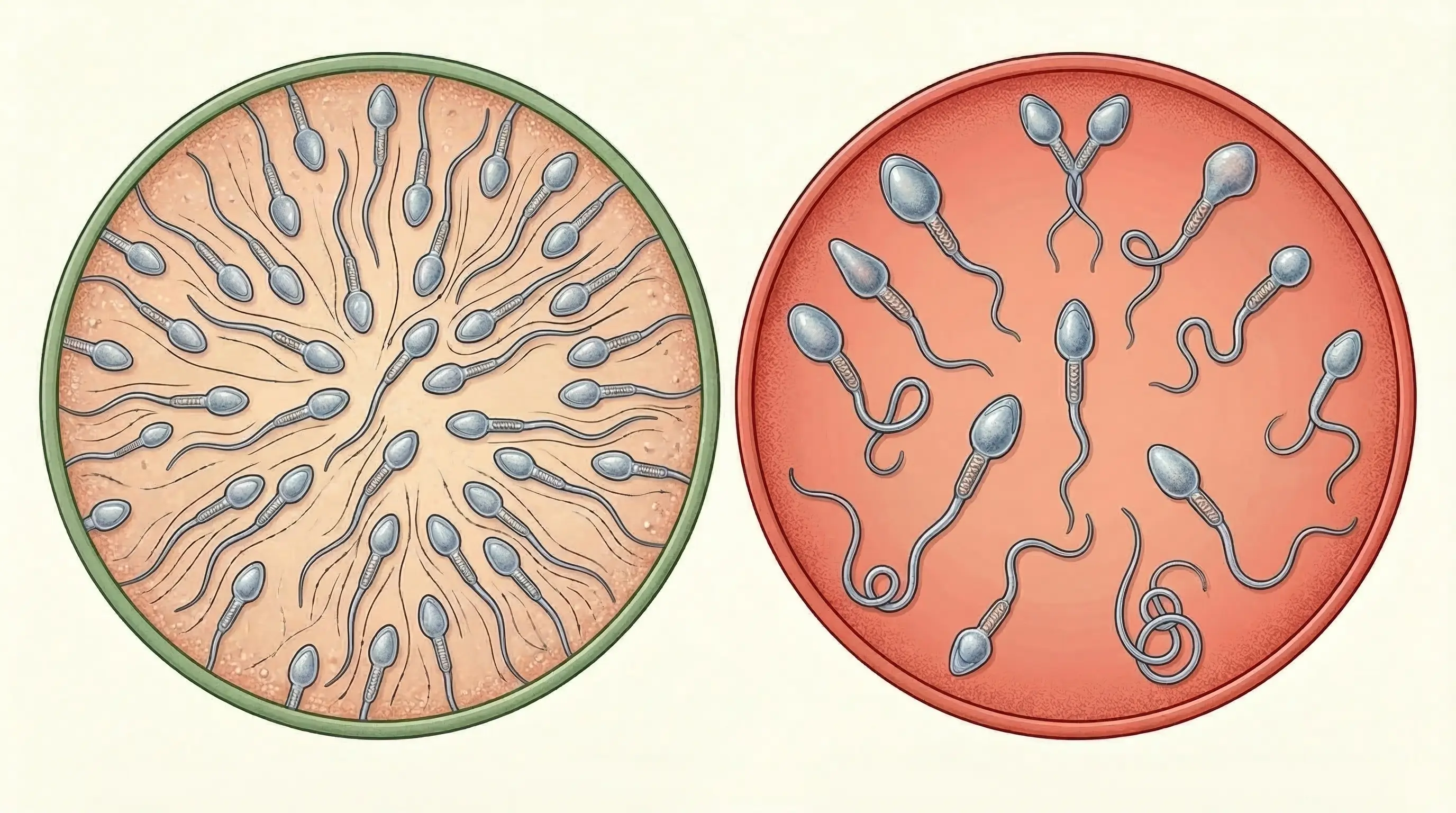



What Is Sperm Quality?
Sperm quality refers to a set of measurable characteristics that determine how well sperm can achieve fertilization. It is assessed through a semen analysis (spermiogram) — the cornerstone of male fertility evaluation, though it does not assess all aspects of fertility potential.[^1][^2]
The World Health Organization (WHO) published the 6th edition of its laboratory manual in 2021, establishing standardized reference values based on data from fertile men across multiple countries.[^1] Both the European Association of Urology (EAU)[^3] and the American Urological Association/American Society for Reproductive Medicine (AUA/ASRM)[^4] guidelines use these values as the clinical standard for evaluating male fertility.
The key parameters measured during a semen analysis include:
Parameter | Lower Reference Limit | 95% CI |
Semen volume | 1.4 ml | 1.3–1.5 |
Total sperm number | 39 million/ejaculate | 35–40 |
Sperm concentration | 16 million/ml | 15–18 |
Total motility (progressive [PR] + non-progressive [NP]) | 42% | 40–43 |
Progressive motility (PR) | 30% | 29–31 |
Vitality (live sperm) | 54% | 50–56 |
Normal morphology | 4% | 3.9–4.0 |
Source: WHO Laboratory Manual, 6th Edition (2021)[^1] and Chung et al. (2024)[^2]
It’s important to understand that these are lower reference limits (5th percentile) — meaning that 95% of fertile men have values above these levels — not thresholds that define fertility or infertility.[^2][^3] A semen analysis alone cannot definitively label a man as fertile or infertile.[^2][^3] If an initial result is abnormal, guidelines recommend repeating the test within 2 to 3 weeks before drawing conclusions.[^3]
→ Learn more: Semen Analysis (Spermiogram)
How Is Sperm Produced?
Understanding sperm production helps explain why masturbation does not “use up” your sperm supply.
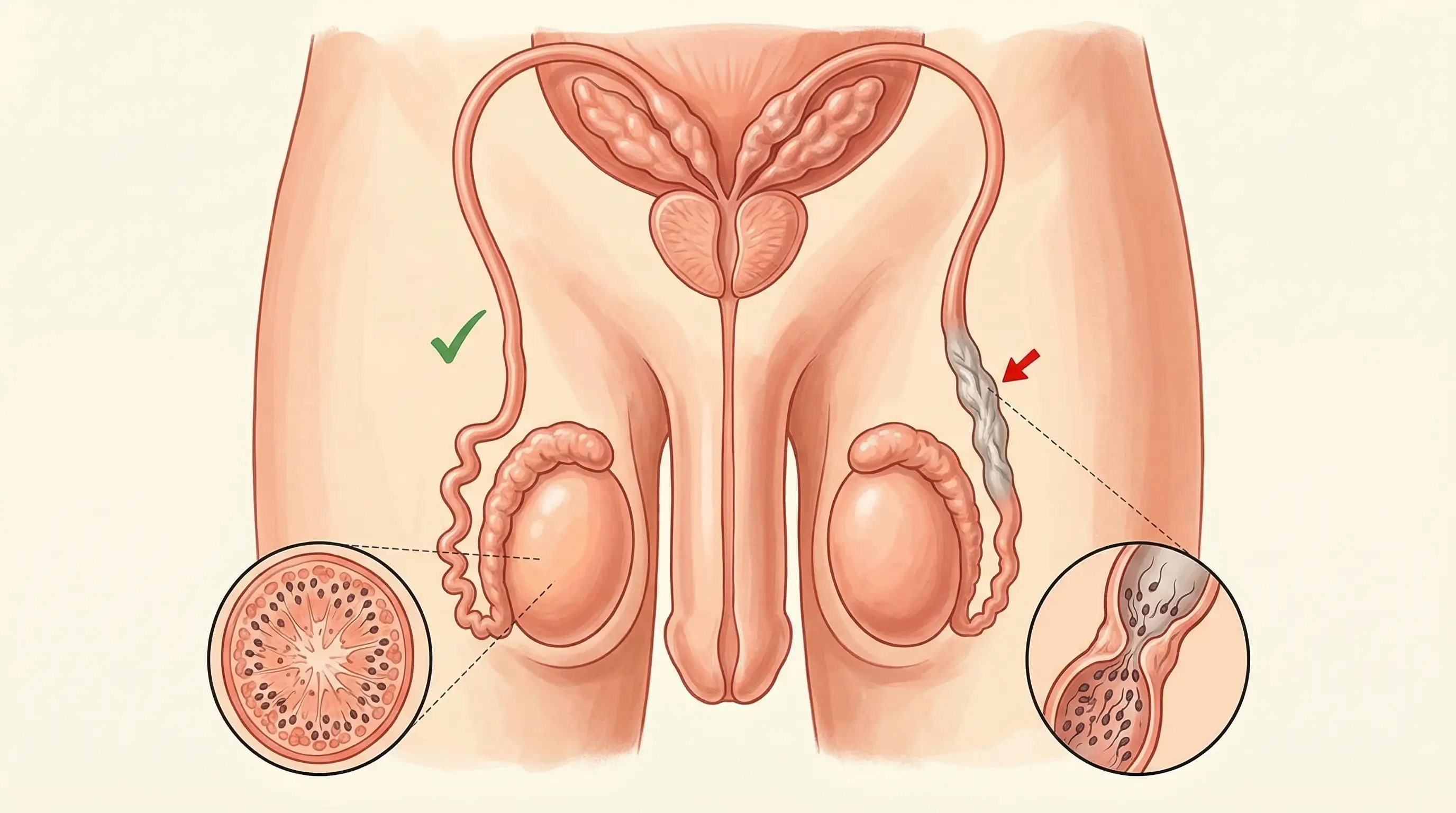
Spermatogenesis — the process of producing mature sperm from stem cells — takes place in the seminiferous tubules of the testes. It is driven by spermatogonial stem cells (SSCs), which continuously balance self-renewal with differentiation to sustain sperm production throughout a man’s entire adult life.[^7]
The complete cycle — from stem cell to mature spermatozoon — takes approximately 74 days in humans.[^7] Once mature, sperm travel through the epididymis (a coiled tube behind the testis), where they acquire motility and are stored until ejaculation. Epididymal transit takes an additional 6 to 10 days.[^16]
This means sperm production is a continuous, overlapping process — your body is always generating new sperm at different stages of development.[^5][^6] Ejaculating does not interrupt or deplete this cycle. It simply releases the sperm already stored in the epididymis, making room for fresher ones.[^16]
A 2025 cross-sectional study of 4,093 men found that higher ejaculation frequency was associated with improved sperm vitality and lower DNA fragmentation, with no negative impact on motility.[^8] The takeaway: more frequent ejaculation does not wear out your reproductive system — it may help “refresh” the supply.
How Does Ejaculatory Abstinence Duration Affect Sperm Parameters?
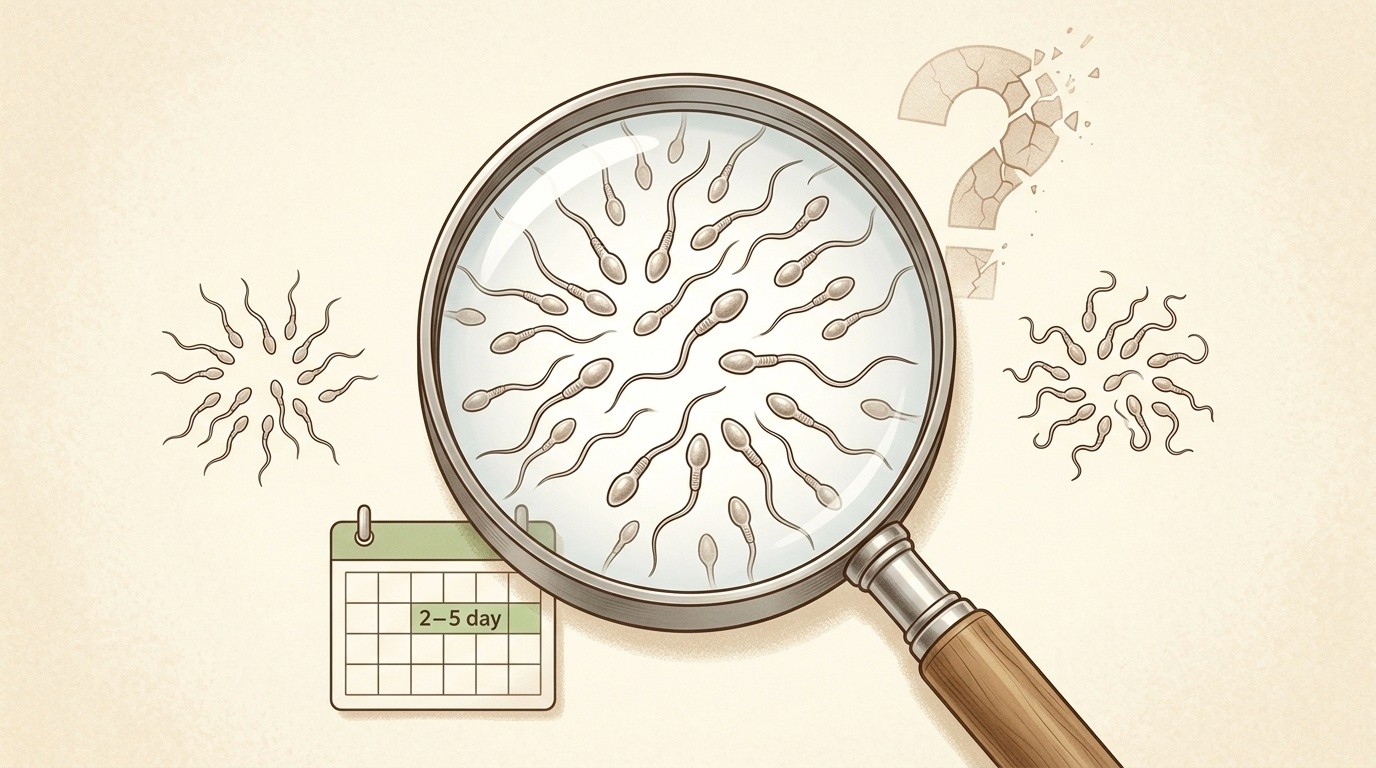
The WHO recommends collecting a semen sample after 2 to 7 days of ejaculatory abstinence for diagnostic purposes.[^1] However, this window was designed for standardization of laboratory testing — not for optimizing sperm quality or fertility outcomes.[^16]
A growing body of evidence shows that the duration of abstinence has a significant impact on conventional semen parameters, and the effects follow a clear pattern:
Longer Abstinence (≥3 Days): More Volume, More Sperm — but Lower Quality
A 2024 meta-analysis of 13 randomized controlled trials (N = 2,315) by Lo Giudice et al. found that long abstinence (≥3 days), compared to short abstinence (<2 days), was associated with:[^9]
Higher semen volume (mean difference: +1.0 ml)
Higher sperm concentration (mean difference: +9.07 million/ml)
Higher DNA fragmentation (mean difference: +3.67%)
No significant improvement in progressive or total motility
Meta-regression revealed a population-level linear trend: for every additional day of abstinence, sperm concentration rose (slope: 3.74 million/ml per day), while DNA fragmentation also increased (slope: 0.65% per day).[^9]
Bottom Line:
Longer abstinence gives you more sperm — but not better sperm. The trade-off is more volume and concentration at the cost of increased DNA damage.
Shorter Abstinence (<2 Days): Less Volume — but Better-Quality Sperm
A 2025 systematic review and meta-analysis of 22 studies (31,640 samples) by Raditya et al. confirmed that shorter abstinence periods (<2 days) led to:[^11]
Reduced semen volume (mean difference: −0.83 ml)
Reduced sperm concentration (mean difference: −8.39 million/ml)
Improved total motility (mean difference: +2.30%)
Improved progressive motility (mean difference: +2.18%)
Reduced DNA fragmentation (mean difference: −3.82%)
In the subgroup of men with oligospermia (low sperm count), short abstinence also significantly improved normal morphology (mean difference: +1.64%).[^11]
A large study analyzing 4,423 semen samples from men with both normal and pathological sperm also found that the effects of abstinence vary depending on the underlying condition.[^10] In men with normal sperm, extended abstinence correlated with higher concentration but reduced progressive motility and morphology. In oligozoospermic men, abstinence beyond 7 days was associated with worse outcomes across all parameters.[^10]
→ Learn more: Asthenozoospermia, Oligozoospermia, and Teratozoospermia
How Do Ejaculation Frequency, Oxidative Stress, and Sperm DNA Fragmentation Relate?
Beyond the conventional parameters visible on a standard semen analysis, there’s a hidden layer of sperm quality that matters enormously for fertility: DNA integrity.
Sperm DNA fragmentation (SDF) is increasingly recognized as an important marker of male fertility potential — often surpassing traditional semen analysis in predicting pregnancy outcomes.[^8] High SDF is linked to infertility, early pregnancy loss, and poorer ART outcomes.[^8][^15]
How Does Abstinence Cause DNA Damage?
When sperm remain stored in the epididymis for prolonged periods, they are exposed to reactive oxygen species (ROS) — highly reactive molecules produced by the sperm themselves and, to a lesser extent, by leukocytes in the reproductive tract.[^12][^13]
ROS at low levels are essential for normal sperm function — including capacitation (sperm activation within the female reproductive tract) and the acrosome reaction (a process in which sperm release enzymes to penetrate the egg).[^13] However, when ROS accumulate in excess, they trigger oxidative stress, which damages sperm through three primary mechanisms:[^12][^13]
Lipid peroxidation: ROS attack the polyunsaturated fatty acids in the sperm membrane, reducing membrane fluidity and impairing motility.[^13]
DNA fragmentation: Single-strand and double-strand breaks accumulate in sperm DNA, compromising genetic integrity.[^12]
Protein oxidation: Key structural proteins are modified, further reducing motility and fertilization capacity.[^13]
The Lo Giudice et al. meta-analysis confirmed a positive linear relationship between days of abstinence and sperm DNA fragmentation.[^9] The longer sperm sit in the epididymis, the greater the ROS exposure and the more damage they accumulate.
Along the same lines, Xi et al. (2025) demonstrated that men who ejaculated 3 or more times per week had significantly lower DNA fragmentation index (DFI) than those who ejaculated less frequently, even after adjusting for age and abstinence time.[^8] Frequent ejaculation essentially “flushes” older, damaged sperm from the epididymis and replaces them with fresher cells that have had less exposure to oxidative stress.
Does Masturbation Frequency Affect Natural Conception Outcomes?
Masturbation is not listed as a cause of male infertility in any major clinical reference, including the StatPearls review, the EAU guidelines, and the AUA/ASRM guidelines.[^3][^4][^14]
However, ejaculatory abstinence duration does matter when it comes to conception — both natural and assisted.
Natural Conception
A 2023 systematic review by Sørensen et al. evaluated 24 studies and confirmed that shorter abstinence periods were associated with improved pregnancy rates, higher live birth rates, and lower DNA fragmentation than longer abstinence periods.[^15] Because sperm DNA integrity correlates with early embryonic development, elevated fragmentation may explain some cases of unexplained early pregnancy loss.[^8]
Assisted Reproduction (IVF/ICSI)
The clinical impact is even clearer in assisted reproduction. The Sørensen et al. review reported that prior meta-analyses showed an improved implantation rate per embryo transferred with short abstinence (OR 1.44; 95% CI 1.17–1.78) and significantly improved live birth rates (OR 1.69; 95% CI 1.1–2.39).[^15]
In a 2024 editorial, Schlegel argued that the standard WHO recommendation of 2 to 7 days of abstinence should be abandoned for semen collection during ART because it was never designed to optimize reproductive outcomes.[^16] At his center, men with cryptozoospermia (extremely low sperm counts) were asked to provide up to four semen samples in a single day. All men were able to comply, and 97% still had sperm available for ICSI from the samples collected on the day of oocyte retrieval. Motility was better in the later, shorter-abstinence samples.[^16]
Key Insight:
Based on this body of evidence, Schlegel recommends that men provide a semen sample with <1 day of abstinence on the day of oocyte retrieval, noting that abstinence as short as 1 to 4 hours may provide sperm with even less damage.[^16] However, this recommendation has not yet been adopted into official clinical guidelines, which still advise 2–7 days of abstinence.[^1][^3]
What Actually Damages Sperm Quality?
While abstinence duration influences sperm quality, it’s not the biggest threat. The real enemies of sperm health are lifestyle and environmental factors — many of which are modifiable.[^3][^17]
Smoking
Cigarette smoke contains approximately 4,700 chemical compounds. A meta-analysis of 5,865 participants found that smoking was associated with a decrease in sperm count (−9.72 million/ml), motility (−3.84%), and morphology (−1.37%).[^17] Smoking also significantly increases sperm DNA fragmentation and chromatin damage.[^17]
Obesity
Excess body fat disrupts the hormonal balance of the hypothalamic–pituitary–gonadal (HPG) axis. Conversion of testosterone to estrogen in fat tissue leads to reduced testosterone levels and impaired sperm production.[^18] Obesity is also associated with increased oxidative stress and higher sperm DNA fragmentation.[^17][^18]
Alcohol and Recreational Drugs
Moderate to heavy alcohol consumption (>25 units per week) has been linked to worse semen parameters. Cannabis use and anabolic steroids are also known factors that can negatively affect the male reproductive system.[^17]
Heat Exposure and Mobile Phones
Prolonged thermal exposure to the scrotum — from laptops, hot tubs, or tight clothing — can impair spermatogenesis. Some evidence suggests that mobile phone radiation carried in trouser pockets may negatively impact sperm motility and viability, though results remain inconclusive regarding concentration.[^17]
Diet: A Protective Factor
On the positive side, adherence to a Mediterranean-style diet — rich in fruits, vegetables, whole grains, fish, nuts, and olive oil — is significantly correlated with better sperm parameters, including concentration, motility, viability, and morphology.[^19] A study of 300 men found that men who followed the Mediterranean diet more closely were significantly more likely to have normal semen parameters compared to those with low adherence.[^19]
→ Learn more: Male Infertility
→ Compare fertility clinics worldwide: MedicalNavigator.com/fertility-clinics
Too Long, Didn’t Read
Masturbation does not cause infertility and is not listed as a risk factor in any major clinical guideline.
Sperm production is a continuous 74-day cycle — ejaculating does not deplete your supply.
Longer abstinence (≥3 days) increases volume and count, but also increases DNA fragmentation and oxidative damage.
Shorter abstinence (<2 days) improves motility and DNA integrity — key factors for both natural conception and ART.
Emerging evidence suggests that shorter abstinence before ART procedures may improve sperm quality, but official guidelines still recommend 2–7 days.
The biggest threats to sperm quality are smoking, obesity, alcohol, heat exposure, and poor diet — not masturbation.
References
[^1]: World Health Organization. WHO laboratory manual for the examination and processing of human semen, 6th ed. 2021.
[^2]: Chung E, Atmoko W, Saleh R, Shah R, Agarwal A. Sixth edition of the World Health Organization laboratory manual of semen analysis: Updates and essential take away for busy clinicians. Arab J Urol. 2024;22(2):71–74.
[^3]: Minhas S, Bettocchi C, Boeri L, et al. European Association of Urology guidelines on male sexual and reproductive health: 2025 update on male infertility. Eur Urol. 2025.
[^4]: Schlegel PN, Sigman M, Collura B, et al. Diagnosis and treatment of infertility in men: AUA/ASRM guideline amendment. J Urol. 2024;211(5):687–698.
[^5]: Holstein AF, Schulze W, Davidoff M. Understanding spermatogenesis is a prerequisite for treatment. Reprod Biol Endocrinol. 2003;1:107.
[^6]: Suede SH, Malik A, Sapra A. Histology, Spermatogenesis. StatPearls [Internet]. 2023.
[^7]: Hwang K, Yatsenko AN, Rajkovic A. Decoding the spermatogenesis program: New insights from transcriptomic analyses. Annu Rev Genet. 2022;56:339–368.
[^8]: Xi J, Wei Y, Zhang Z, Wu X, Sun Y, Li X. Impact of ejaculation frequency on semen parameters and DNA fragmentation: a cross-sectional study. Reprod Biol Endocrinol. 2025;23(1):100.
[^9]: Lo Giudice A, Cannarella R, Condorelli RA, et al. Effects of long and short ejaculatory abstinence on sperm parameters: a meta-analysis of randomized controlled trials. Front Endocrinol. 2024;15:1373426.
[^10]: Xie M, Hämmerli S, Leeners B. The association between abstinence period and semen parameters in humans: Results in normal samples and different sperm pathology. Life. 2024;14(2):188.
[^11]: Raditya M, Soejono AH, Siswanto MA, et al. Impact of shorter abstinence periods on semen parameters: A systematic review and meta-analysis. World J Mens Health. 2025;43(3):563–579.
[^12]: Ayad B, Omolaoye TS, Louw N, et al. Oxidative stress and male infertility: Evidence from a research perspective. Front Reprod Health. 2022;4:822257.
[^13]: Serrano-Díaz A, Álvarez-Sánchez ME, García-Roselló M. Mechanisms of oxidative stress-induced sperm dysfunction. Front Physiol. 2025.
[^14]: Leslie SW, Soon-Sutton TL, Khan MAB. Male Infertility. StatPearls [Internet]. 2024.
[^15]: Sørensen AL, Crüger D, Nielsen CH, et al. The influence of ejaculatory abstinence time on pregnancy rate, live birth rate and sperm DNA fragmentation: A systematic review. J Clin Med. 2023;12(6):2219.
[^16]: Schlegel PN. We are giving the wrong patient instructions for semen analysis before ART. Fertil Steril. 2024;121(1):38–39.
[^17]: Rotimi DE, Adefegha SA, Adeyemi OS, Akinrinola BL. Implications of lifestyle factors on male reproductive health. J Basic Clin Physiol Pharmacol. 2024;35(1):23–37.
[^18]: Leisegang K, Sengupta P, Agarwal A, Henkel R. Obesity and male infertility: Mechanisms and management. Andrologia. 2021;53:e13617.
[^19]: Garolla A, Petre GC, Francini-Pesenti F, et al. Mediterranean diet and sperm parameters in fertile and infertile men: A cross-sectional study. Nutrients. 2023;15(24):5036.
This guide is for informational purposes only. Always consult qualified healthcare providers for personalized recommendations. For full details, read our Medical Disclaimer.

Author of the article
Date of publication