


How Age Affects Fertility
Fertility does not switch off overnight. It follows a gradual, biologically programmed decline that affects both women and men — though the timelines and mechanisms differ.
For women, the decline may begin as early as the late twenties to early thirties, accelerates after 35, and becomes steep after 40.[^1][^4] The core issue is twofold: the number of eggs drops (ovarian reserve) and the quality of remaining eggs worsens (more chromosomal errors).[^5][^6]
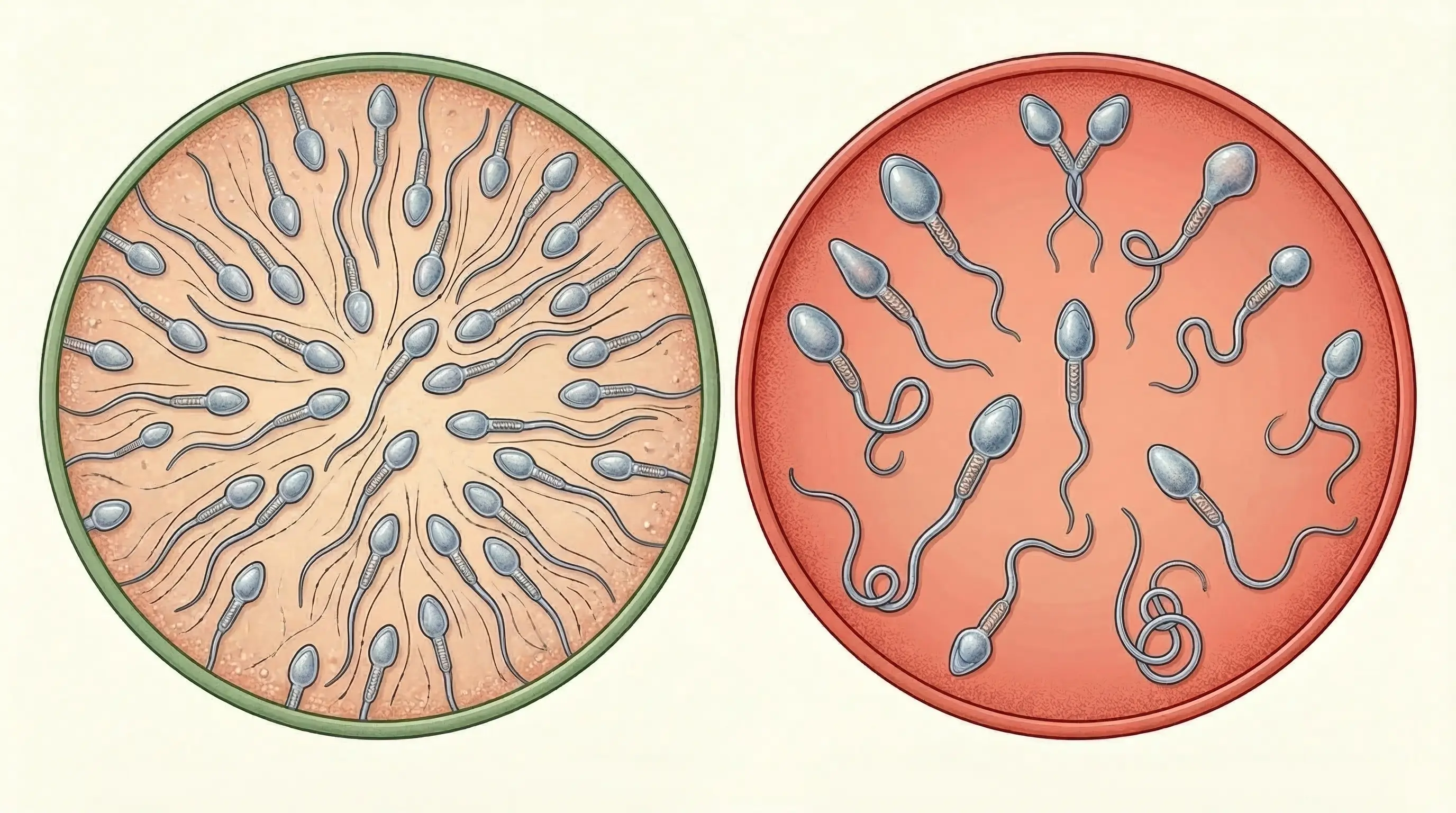
For men, fertility declines more gradually. Semen volume, sperm motility and morphology may begin to change after age 34–35, with more pronounced effects after 40.[^7][^8] Critically, sperm DNA integrity — invisible on a standard semen analysis — deteriorates with age, raising the risk of failed implantation, miscarriage and health problems in offspring.[^2][^9]
The combined effect of both partners’ ages means that couples in which both individuals are older face compounded challenges. Early awareness and proactive planning can make a meaningful difference.[^4]
→ Learn more: Infertility
Female Fertility and Age
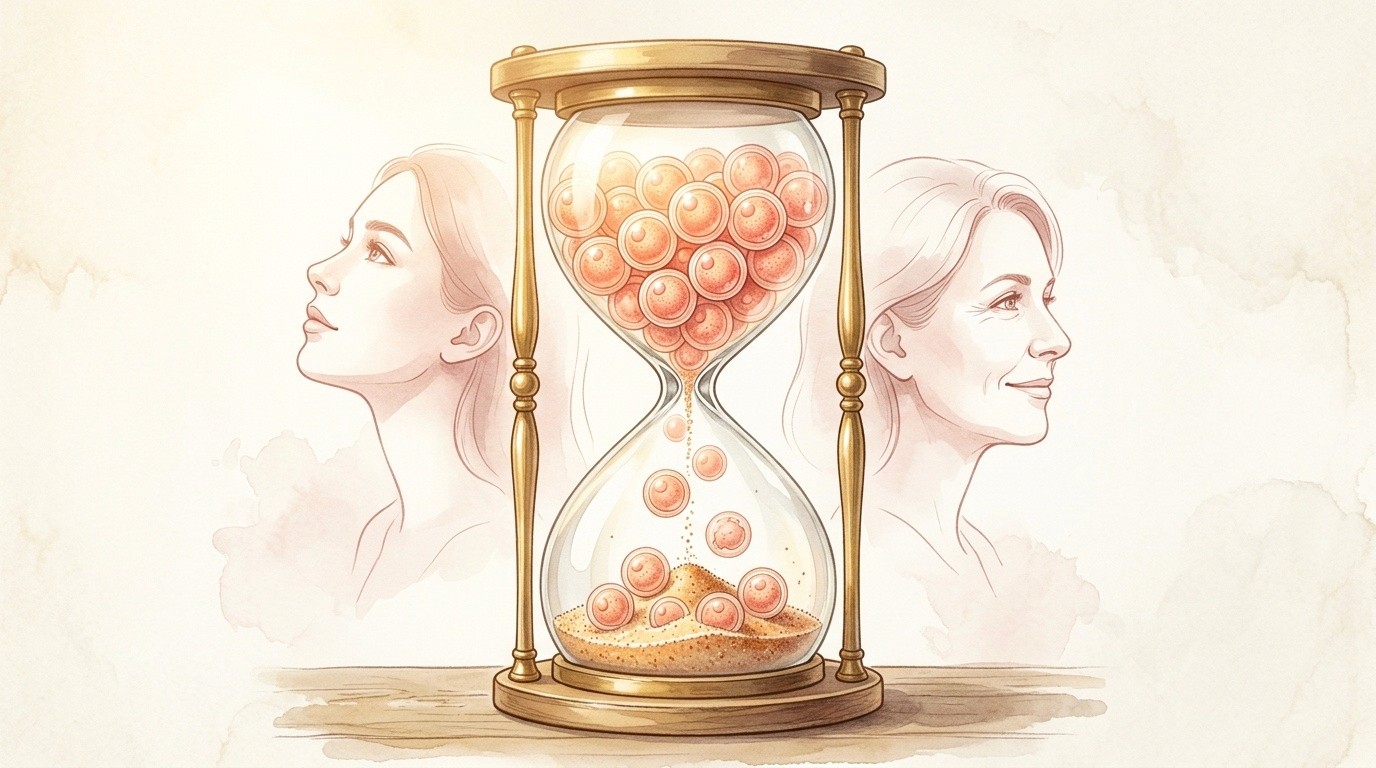
Women are born with a finite pool of eggs — approximately 1–2 million oocytes at birth.[^5][^10] By puberty, this number has already fallen to around 300,000–500,000, and no new eggs are ever created after that. Through a continuous process of follicular atresia and ovulation, this pool shrinks throughout life until only a few hundred remain at menopause.[^6]
Egg Quantity: The Numbers
The rate of follicle loss is not constant — it accelerates with age. By age 35, the pace of decline increases significantly.[^6][^10] During her entire reproductive life, a woman ovulates only about 500 eggs; the vast majority are lost to follicular atresia (the natural process in which follicles fail to develop and are reabsorbed before ovulation).[^6]
Egg Quality: The Hidden Factor
As a woman ages, her remaining eggs are more likely to contain chromosomal errors (aneuploidy). This is the primary reason why older women experience:[^11]
Lower implantation rates — aneuploid embryos are less likely to implant successfully
Higher miscarriage rates — from approximately 10% at ages 20–24 to approximately 50% at ages 40–44[^1]
Increased risk of chromosomal conditions such as Down syndrome
The underlying mechanisms include mitochondrial dysfunction, oxidative stress, telomere shortening and disturbances in the hormonal axis connecting the brain to the ovaries (the HPO axis).[^6]
The Optimal Reproductive Window
The optimal reproductive age, balancing biological, medical and social factors, generally spans 20 to 35 years, with peak fertility in the early to mid-twenties.[^1] Monthly conception probability reaches 25–30% in the early twenties, then declines gradually.[^1]
Age Group | Monthly Conception Rate | Miscarriage Risk |
20–24 years | Approximately 25–30% | Approximately 10% |
25–29 years | Approximately 20–25% | Approximately 10–15% |
30–34 years | Approximately 15–20% | Approximately 15–20% |
35–39 years | Approximately 10–15% | Approximately 20–35% |
40–44 years | <5% | Approximately 40–50% |
Sources: Adebisi OY et al., StatPearls (2025);[^1] ACOG Committee Opinion No. 589 (2014)[^4]
→ Learn more: Female Infertility
Ovarian Reserve and AMH
Ovarian reserve refers to the number of eggs remaining in the ovaries at a given time. It is assessed primarily through two markers:[^5]
AMH (Anti-Müllerian Hormone): A blood test. AMH is produced by small growing follicles and declines as the follicle pool shrinks with age.[^5][^12]
AFC (Antral Follicle Count): An ultrasound-based count of small follicles visible on the ovaries.[^5]
What AMH Can Tell You?
AMH and AFC are good predictors of ovarian response to stimulation (the number of eggs retrieved during IVF). They help clinicians plan medication doses and set realistic expectations about egg yield.[^5]
What AMH Cannot Tell You?
AMH and AFC have only a weak association with egg quality, clinical pregnancy rates and live birth rates.[^5] In other words, a low AMH does not automatically mean you cannot conceive naturally, and a normal AMH does not guarantee it. Multiple factors — including age, sperm quality, embryo development and laboratory techniques — all play significant roles.[^5]
Ovarian reserve markers were also shown to be poor predictors of fecundability (the probability of conceiving in a given menstrual cycle) in women trying to conceive naturally.[^5]
Key takeaway:
Ovarian reserve tests estimate egg quantity, not egg quality or the chance of natural conception in a given month. Age remains the strongest single predictor of reproductive potential.[^5]
Age-Related Fertility Outcomes in Women
Aneuploidy and Maternal Age
A landmark study of 15,169 embryo biopsies demonstrated a clear relationship between maternal age and the rate of chromosomal abnormalities (aneuploidy) in embryos:[^11]
Age Group | Aneuploidy Rate | No Euploid Embryo Rate |
26–30 years | 20–27% | 2–6% |
31–34 years | Rising steadily | 2–6% |
35–38 years | Continues to rise | Gradual increase |
39–42 years | High | Approximately 33% at age 42 |
43+ years | Approximately 85% (plateau) | Approximately 53% at age 44 |
Source: Franasiak JM et al., Fertility and Sterility (2014)[^11]
The lowest risk for embryonic aneuploidy was between ages 26 and 30. After age 43, the aneuploidy rate plateaued at approximately 85%.[^11] As age increased, not only did more embryos carry errors, but those errors became more complex — involving multiple chromosomes simultaneously.[^11]
This is one reason why preimplantation genetic testing (PGT-A) becomes increasingly relevant for older patients. PGT-A screens embryos for chromosomal abnormalities before transfer, allowing clinicians to select euploid embryos and improve the chance of a successful pregnancy. For women over 38–40, where the majority of embryos may be aneuploid, PGT-A can help avoid futile transfers and reduce time to a live birth.[^11]
IVF Success Rates by Age
Assisted reproductive technology (ART) outcomes are strongly influenced by female age. Recent data show the following approximate live birth rates per cycle using a woman’s own eggs:[^1]
Age | Live Birth Rate per Cycle |
Under 35 years | Approximately 48.5% |
35–37 years | Approximately 38.3% |
38–40 years | Approximately 26.8% |
41–42 years | Approximately 11–13% |
Over 42 years | Approximately 4–7% |
Source: Adebisi OY et al., StatPearls (2025);[^1] CDC ART National Summary Report
Cumulative live birth rates improve with multiple cycles, but the gap between younger and older women remains substantial. Part of this gap reflects the fact that many women over 42 do not complete multiple cycles — after a first retrieval with poor response, they are often redirected toward donor egg cycles. For women over 42 using their own eggs, the cumulative live birth rate after three cycles falls below 10%.[^1]
Male Fertility and Age
Unlike female fertility, male fertility does not have a definitive endpoint — men can produce sperm throughout their lives. However, both the quantity and quality of sperm decline with age, and the consequences extend beyond simple conception rates.[^7][^8]
→ Learn more: Male Infertility
Changes in Semen Parameters
Research shows that age-related negative changes in sperm quality become apparent in men over 35 years of age, with effects becoming more pronounced after 40.[^2][^8] Key findings include:
Semen volume declines significantly with age [^2][^8]
Sperm motility shows a progressive age-related decline, becoming more clinically pronounced after 40–45 in most studies [^9]
Sperm morphology (normal shape) shows a gradual age-related decline; the clinical significance of this change is most prominent in men over 40, though some studies report detectable shifts from the mid-thirties [^9]
Sperm concentration appears to be the least affected parameter by age [^9]
Between the ages of 30 and 50, differences of 3–22% in semen volume, 3–37% in motility, and 4–18% in morphology have been reported.[^9]
Sperm DNA Integrity: The Invisible Factor
Standard semen analysis measures count, motility and morphology — but does not assess DNA integrity. A study of 1,124 men found that men aged ≥40 had a significantly higher sperm DNA fragmentation index (DFI) than younger men.[^2] Older men had over twice the odds of clinically relevant DNA damage (>10% DFI) compared to men under 40 — regardless of whether their standard semen parameters were normal.[^2]
DFI thresholds are not yet fully standardized across guidelines — some use 15% as a threshold of concern, others 25% or higher as a marker of significant clinical impact. Results should always be interpreted by a specialist in the context of the full clinical picture.
Key takeaway:
Sperm DNA fragmentation testing may have greater clinical utility than standard semen analysis alone for assessing male fertility potential, particularly in men over 40.[^2]
Advanced Paternal Age
Advanced paternal age (APA), generally defined as ≥40 years, carries consequences that extend beyond sperm quality. It affects the chances of conception, pregnancy outcomes, and the health of future children.[^3][^9]
Effects on Conception and Pregnancy
Multiple studies have shown that APA is associated with a longer time to pregnancy and reduced success with assisted reproduction.[^9] In one IUI-based study, Belloc et al. reported that the pregnancy rate dropped from 12.3% per cycle in men aged 30–44 to 9.3% in men aged 45–54, though this was a single study and the finding is specific to intrauterine insemination.[^9]
Miscarriage Risk
A systematic review and meta-analysis by du Fossé et al. confirmed that advanced paternal age is associated with an increased risk of spontaneous miscarriage.[^3] Other data show that when maternal age is held constant at 20–29 years, the odds ratio for miscarriage increases from 1.06 (paternal age 30–34) to 1.31 (35–39) to 1.80 (40–64).[^9] In the same IUI cohort, Belloc et al. found the miscarriage rate rose from 13.7% with fathers aged ≤30 to 32.4% with fathers aged ≥45.[^9]
Risks to Offspring Health
Advanced paternal age has been linked to increased risks in children, including:[^2][^9]
Autism spectrum disorders and schizophrenia, especially when paternal age is ≥40–50 years[^9]
Autosomal dominant conditions such as achondroplasia, Marfan syndrome, Apert syndrome and neurofibromatosis[^9]
Congenital heart defects in children of fathers over 35–45[^9]
De novo mutations — germline single base-pair alterations increase at a rate of approximately two per year of paternal age[^9]
Fertility Preservation and Age
Fertility preservation allows individuals to freeze reproductive cells now for use later. The single most important factor determining success is the age at which eggs or sperm are frozen.[^13][^14]
Egg Freezing (Oocyte Cryopreservation)
The number of eggs needed to achieve a reasonable chance of a live birth in the future depends on the woman’s age at freezing. ASRM estimates suggest that to achieve a 70% chance of at least one live birth, women aged 30–34 would need approximately 14 mature oocytes, women aged 35–37, approximately 15 mature oocytes, and women aged 38–40, approximately 26 mature oocytes. The actual number of retrieval cycles needed will vary on a case-by-case basis, depending on ovarian response and other individual factors.[^14]
The first human pregnancy from a cryopreserved oocyte was reported in 1986.[^14] Since then, vitrification (rapid cooling) has become the standard technique, dramatically improving post-warming egg survival.[^14]
In 2013, the ASRM declared that oocyte freezing is no longer experimental. It is now used for medical indications (cancer treatment, gonadotoxic therapies), social or “planned” egg freezing, and oocyte donation.[^14]
Age at freezing is critical. Women who freeze eggs earlier — particularly before 35 — tend to achieve better egg survival, higher fertilization rates, and ultimately better live birth outcomes per egg frozen. For women aged 38–40, planned egg freezing is less of a “backup option” and more of a primary strategy to improve the chances of a future pregnancy, given that natural conception rates are already significantly reduced at this age.[^14] Neonatal outcomes appear similar whether fresh or cryopreserved oocytes are used.[^14]
The ESHRE guideline acknowledges the growing demand for oocyte cryopreservation due to age-related fertility loss and recommends thorough counseling on expected success rates, which are influenced by the number of eggs frozen and the age at retrieval.[^13]
Male Fertility Preservation
Sperm cryopreservation (sperm banking) remains a well-established option for men. The freezing process does reduce some semen parameters — post-thaw survival rates typically range from 40% to 60%, depending on the original sample quality and the freezing protocol used. For this reason, banking multiple samples on separate occasions is generally recommended to ensure sufficient sperm is available for future use.[^15]
Sperm banking is especially important before cancer treatment or other gonadotoxic therapies.[^15] Recent advances also include testicular tissue cryopreservation for prepubertal boys facing gonadotoxic treatment.[^15]
→ Learn more: Do Frozen Eggs, Sperm, and Embryos Last Forever?
Clinical Decision Making and Timing
Approximately 85% of couples conceive within the first 12 months of regular, unprotected intercourse, with about 30–40% achieving pregnancy in the first 3 months.[^1] Population-based studies indicate an average monthly conception probability of 15–20% in the general population.[^1]
When to Seek Help
Age | When to See a Fertility Specialist |
Under 35 years | After 12 months of trying to conceive. |
35 years and older | After 6 months of trying to conceive. |
40 years and older | Immediately — do not delay. |
Known risk factors at any age | Seek evaluation sooner. |
Source: ASRM Optimizing Natural Fertility (2022);[^4] Adebisi OY et al., StatPearls (2025)[^1]
Earlier evaluation and treatment may be justified on the basis of medical history and physical findings, and is warranted after 6 months for women aged 35 years and older due to the accelerated decline in fertility.[^4]
Natural fertility tends to be overestimated, and delayed childbearing is often overlooked as a risk factor for infertility.[^8] Clinicians have an essential role in educating patients about age-related fertility decline starting at an early age.[^8]
Living with Age-Related Fertility Concerns
The emotional burden of age-related fertility concerns is real and significant — for both women and men. Infertility can affect self-esteem, relationships and overall well-being.[^16][^17]
Psychological Impact
Men with infertility often receive less emotional and psychological support during treatment compared to their female partners, despite experiencing comparable levels of stress.[^17] This imbalance may negatively impact treatment adherence, relationship satisfaction and overall well-being.[^17]
In patriarchal societies, fertility is closely tied to perceptions of masculinity and social identity, which can intensify feelings of shame and isolation.[^17]
Evidence for Psychological Interventions
A meta-analysis of 69 studies involving 5,935 women found that psychological interventions produced significant reductions in anxiety and depression, and a large, significant improvement in overall well-being.[^18] Additional evidence confirms that structured psychological support can reduce infertility-related distress for both partners.[^16][^19]
The ESHRE psychosocial care guideline recommends that fertility clinics provide routine psychosocial care, including information about patient preferences and access to counseling services.[^19]
Key takeaway:
Do not hesitate to seek emotional support. Psychological care is an evidence-based component of comprehensive fertility treatment, not an optional add-on.
So, What Should You Do Now?
If age-related fertility is on your mind, here is a clear path forward:
Step 1: Know Your Timeline
Under 35? You have time, but awareness matters. If you have specific health concerns — such as a family history of early menopause, previous ovarian surgery, or irregular cycles — speak with a specialist. Routine AMH testing is not generally recommended for otherwise healthy women in this age group.
35–39? The window is narrowing. Seek specialist evaluation after 6 months of trying.
40+? Consult a fertility specialist now. Every month counts.
Step 2: Get Both Partners Evaluated
For her: Hormonal panel (including AMH), transvaginal ultrasound (AFC), and if indicated, HSG.
For him: Semen analysis (spermiogram). Consider sperm DNA fragmentation testing if over 40.
Step 3: Consider Fertility Preservation
If you are not ready for children yet, egg freezing (for women) or sperm banking (for men) can preserve options. The younger you freeze, the higher the probability of success.
Step 4: Choose the Right Clinic
If you need assisted reproduction, choose a clinic based on reported success rates, available treatments, costs and clinician experience.
→ Compare fertility clinics worldwide: MedicalNavigator.com/fertility-clinics
Too Long, Didn’t Read
Female fertility declines gradually after 30, more sharply after 35 and significantly after 40.
Male fertility also declines — semen parameters may begin to change from the mid-thirties, with sperm DNA damage more than doubling after 40.
Aneuploidy (chromosomal errors in embryos) rises predictably with maternal age; the lowest risk is between ages 26 and 30.
AMH and AFC measure egg quantity, not egg quality — age remains the best predictor of reproductive potential.
Advanced paternal age (≥40) increases miscarriage risk and the chance of genetic conditions in offspring.
Fertility preservation works best when done at a younger age — particularly before 35 for women.
References
[^1]: Adebisi OY, Singh M, Tobler KJ. Female Infertility. [Updated 2025 Nov 30]. In: StatPearls [Internet]. Treasure Island (FL): StatPearls Publishing; 2025 Jan–.
[^2]: Rosiak-Gill A, Gill K, Jakubik J, et al. Age-related changes in human sperm DNA integrity. Aging. 2019;11(15):5399–5411.
[^3]: du Fossé NA, van der Hoorn MLP, van Lith JMM, le Cessie S, Lashley EELO. Advanced paternal age is associated with an increased risk of spontaneous miscarriage: a systematic review and meta-analysis. Hum Reprod Update. 2020;26(5):650–669.
[^4]: Practice Committee of the ASRM. Optimizing natural fertility: A committee opinion. Fertility and Sterility. 2022.
[^5]: Practice Committee of the ASRM. Testing and interpreting measures of ovarian reserve: A committee opinion. Fertility and Sterility. 2020;114(6):1151–1157.
[^6]: Wang X, Wang L, Xiang W. Mechanisms of ovarian aging in women: a review. J Ovarian Res. 2023;16(1):67.
[^7]: Kaltsas A, Moustakli E, Zikopoulos A, et al. Impact of Advanced Paternal Age on Fertility and Risks of Genetic Disorders in Offspring. Genes. 2023;14(2):486.
[^8]: Owen A, Carlson K, Sparzak PB. Age-Related Fertility Decline. [Updated 2024 Feb 2]. In: StatPearls [Internet]. Treasure Island (FL): StatPearls Publishing; 2025 Jan–.
[^9]: Jimbo M, et al. Fertility in the aging male: a systematic review. Fertil Steril. 2022.
[^10]: Broekmans FJM, et al. Female reproductive ageing: current knowledge and clinical implications. Hum Reprod Update. 2023;29(1):1–25.
[^11]: Franasiak JM, Forman EJ, Hong KH, et al. The nature of aneuploidy with increasing age of the female partner: a review of 15,169 consecutive trophectoderm biopsies. Fertil Steril. 2014;101(3):656–663.e1.
[^12]: Anderson RA, Cameron D, Clatot F, et al. Anti-Müllerian hormone as a marker of ovarian reserve and premature ovarian insufficiency in children and women with cancer: a systematic review. Hum Reprod Update. 2022;28(3):417–434.
[^13]: European Society of Human Reproduction and Embryology (ESHRE). Guideline: Female fertility preservation. Hum Reprod Open. 2020;2020(4).
[^14]: Practice Committee of the ASRM. Evidence-based outcomes after oocyte cryopreservation for donor oocyte in vitro fertilization and planned oocyte cryopreservation: a guideline. Fertil Steril. 2021;116(1):36–47.
[^15]: Doungkamchan C, Orwig KE. Recent advances: fertility preservation and fertility restoration options for males and females. Faculty Reviews. 2021;10:55.
[^16]: Dubé L, et al. Efficacy of psychological interventions for mental health and pregnancy outcomes in infertility: A meta-analysis of randomized controlled trials. Hum Reprod Update. 2023;29(1):71–92.
[^17]: Sahoo S, Das A, Dash R, et al. The Psychological Impact of Male Infertility: A Narrative Review. Cureus. 2025;17(8):e89453.
[^18]: Jackson PL, Saunders P, Mizzi S, et al. The efficacy of psychological interventions for infertile women: A systematic review and meta-analysis. BMC Women’s Health. 2025;25:506.
[^19]: ESHRE. Psychosocial care in infertility and medically assisted reproduction — A guide for fertility staff.
[^20]: American Urological Association. Male Infertility — Medical Students Curriculum.
[^21]: European Association of Urology (EAU). Guidelines: Male Infertility.
This guide is for informational purposes only. Always consult qualified healthcare providers for personalized recommendations. For full details, read our Medical Disclaimer.

Author of the article
Date of publication